
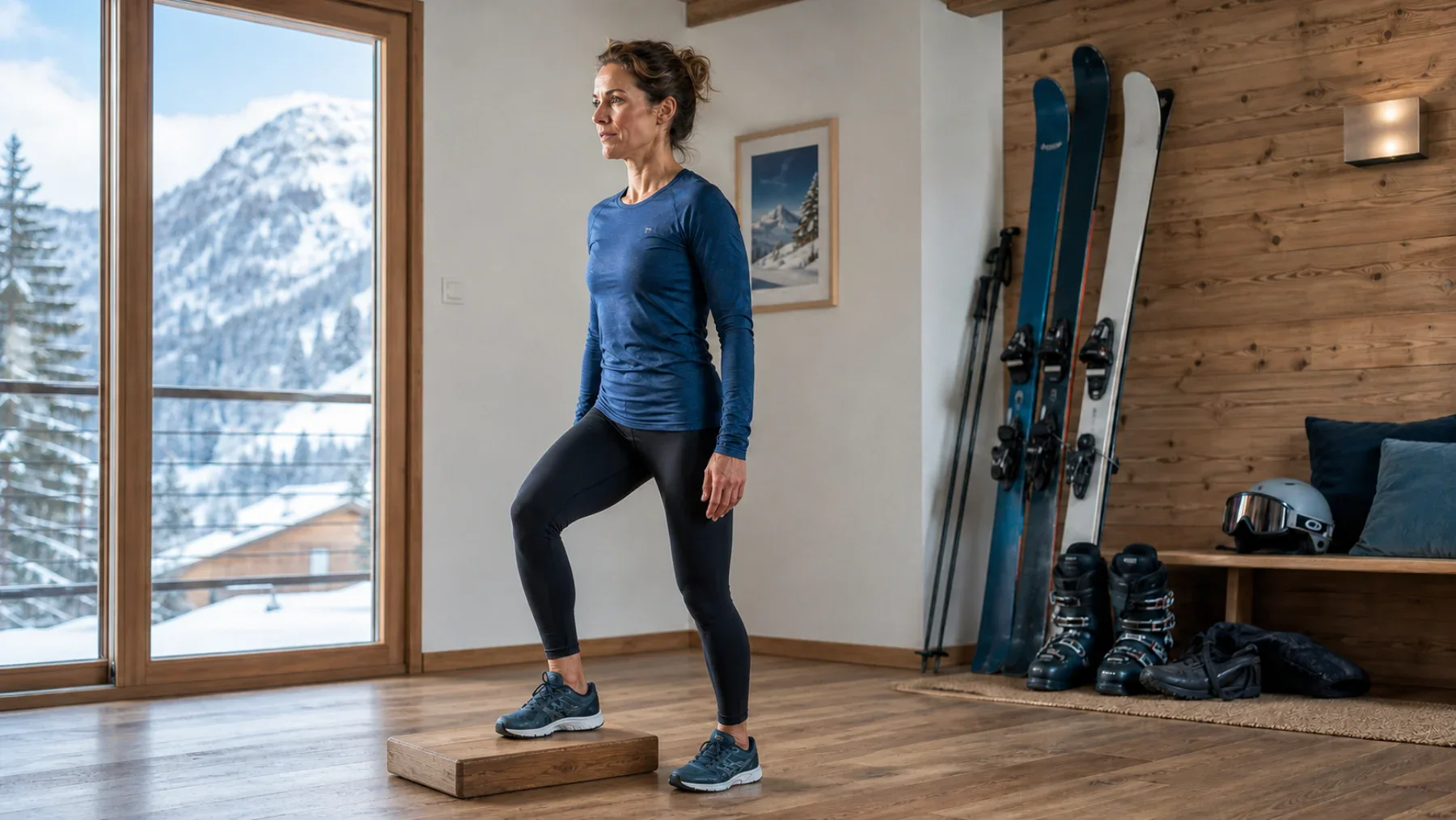
First run: 25–30 minutes
Use the shorter version to find the right step height, range and exercise variations.
- Keep the full 6-minute warm-up.
- Do two sets instead of three for each Block A exercise.
- Complete only one Block B round and hold the wall squat for 20 seconds.
- Use no extra load. Note which exercise became less controlled first.
What you need before you start
Set everything out before the warm-up. Stability matters more than height when you choose the step.
Low step
A solid step or platform about 10–20 centimetres high. It must not rock or slide.
Support
A wall, rail or heavy chair back for the single-leg exercises.
Timer
Set 30, 60 and 75 seconds. Rest periods are part of the workout.
Optional load
A backpack or two dumbbells. Add them only after the bodyweight version stays controlled.
Why the exercises come in this order
The most demanding controlled work comes first. The shorter circuit starts after the more technical repetitions are complete.
-
6 min
Warm up
Raise your temperature and rehearse the movements without extra load.
-
8–9 min
Control the lowering phase
Do step-downs at a fixed tempo while concentration and balance are fresh.
-
14–16 min
Build single-leg strength
Complete forward lunges and single-leg Romanian deadlifts as separate sets.
-
10–12 min
Add strength endurance
Use lateral work, calves and a wall hold for two steady rounds.
-
2–3 min
Finish
Walk easily and write one short training note.
Warm-up: 6 minutes, no jumping
Use a range you can control without shifting around it. By the final step you should feel warmer and still be able to speak normally.
-
60 sec
Brisk march
Place the whole foot down and let your arms swing naturally.
-
8 reps
Squat to the step
Touch the step lightly with your hips, then stand. Keep knees and feet pointing the same way.
-
6 each side
Reverse lunge
Step one foot back briefly, then return to standing. Keep the range shallow.
-
8 reps
Two-leg hip hinge
Send your hips back, keep your back long and stand by extending through the hips.
-
8 reps
Calf raise
Lift both heels smoothly, then lower them all the way.
Block A: controlled strength first
Finish every set of one exercise before moving on. This block is not a circuit. Choose a range that keeps the final rep looking like the first, with roughly two clean reps still available.
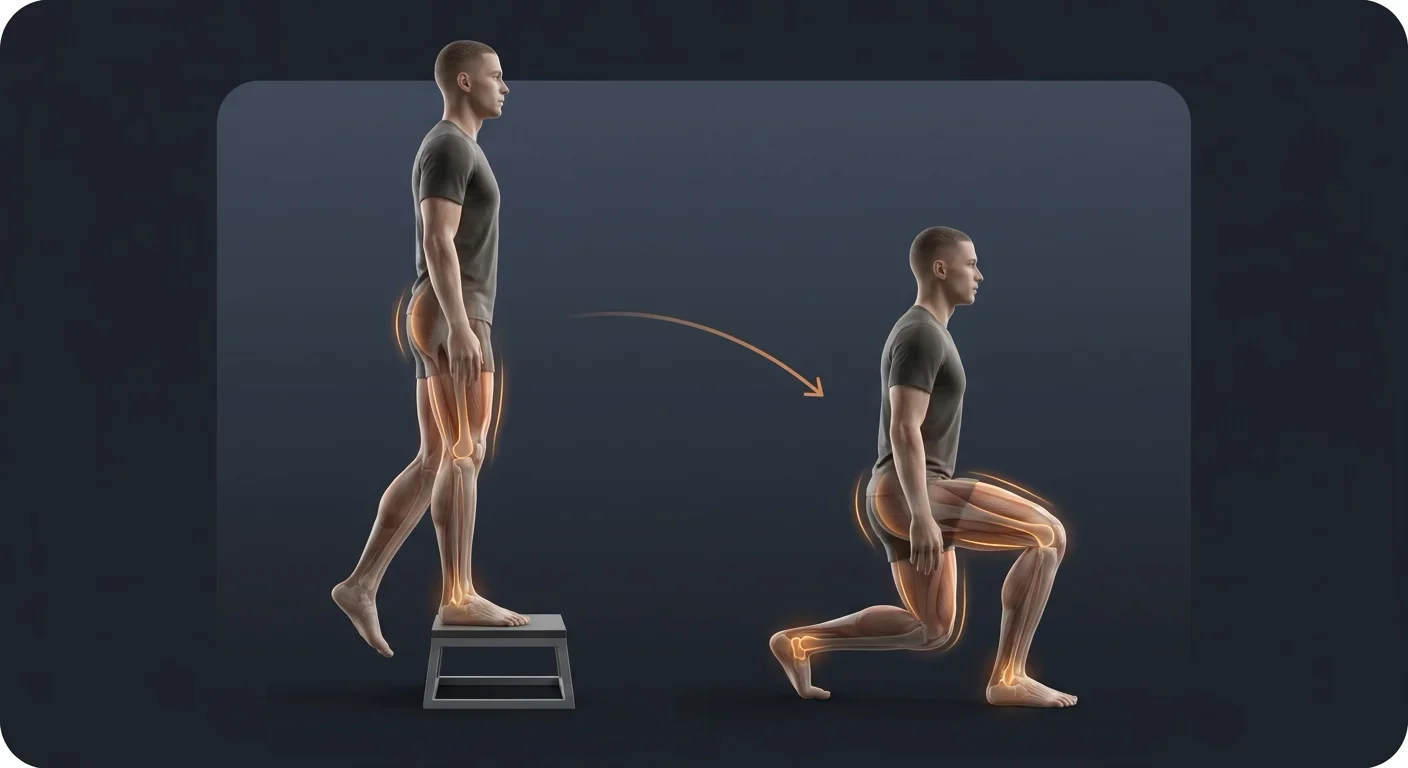
Exercise 1
Eccentric step-down
- Dose
- 3 × 6 each side · 3 sec down
- Muscles and task
- Quadriceps, glutes and control of the pelvis, knee and foot
Watch for: Keep your whole foot on the step. Lower the free heel towards the floor for three seconds, then return under control. Keep the pelvis and standing foot quiet.
Rest: 60–75 seconds after both sides.
Make it easier: Use a lower step, hold a support lightly or shorten the range.
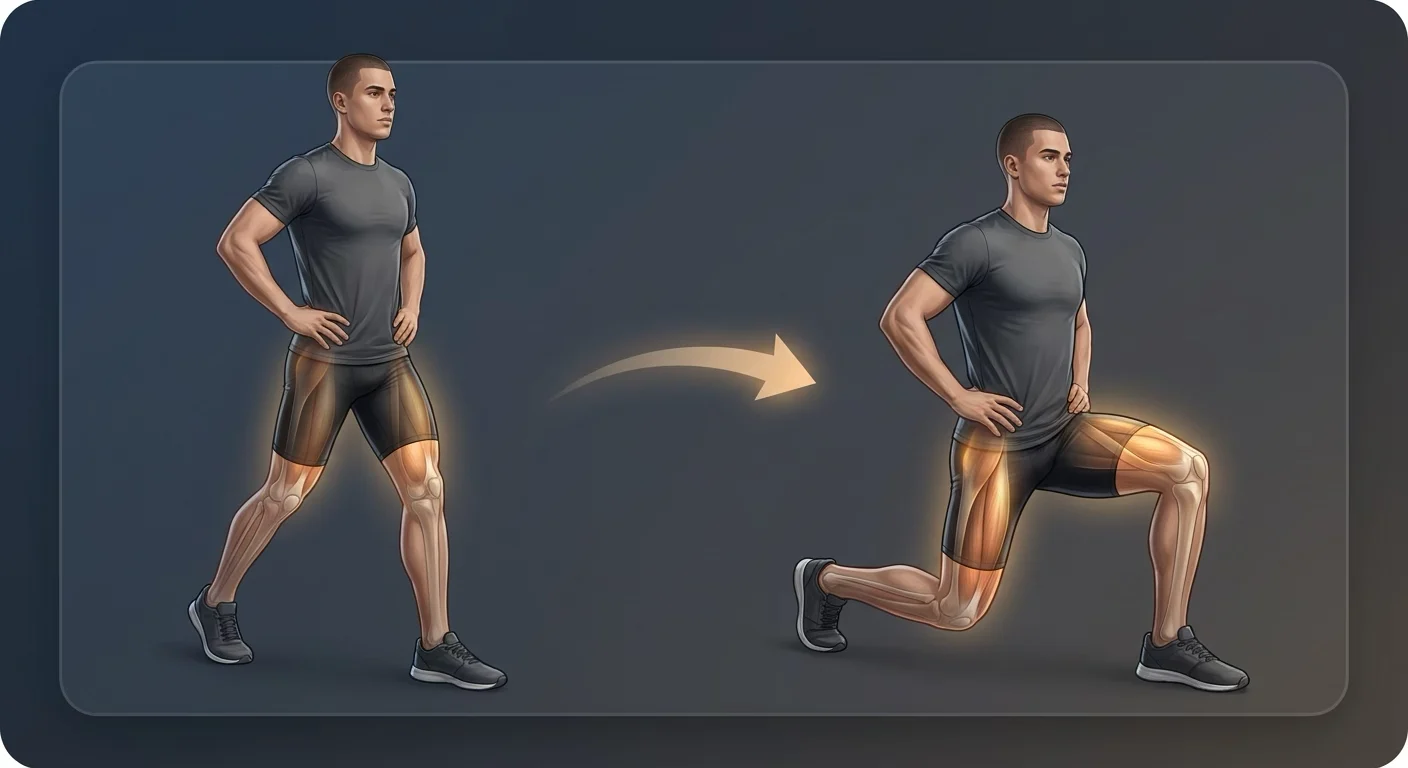
Exercise 2
Forward lunge
- Dose
- 3 × 8 each side
- Muscles and task
- Quadriceps, glutes, adductors and single-leg stability
Watch for: Step far enough forward, lower smoothly and push through the whole front foot to return. Keep the knee and toes pointing the same way.
Rest: 60–75 seconds after both sides.
Make it easier: Stay in a split stance, hold a support and move straight up and down.
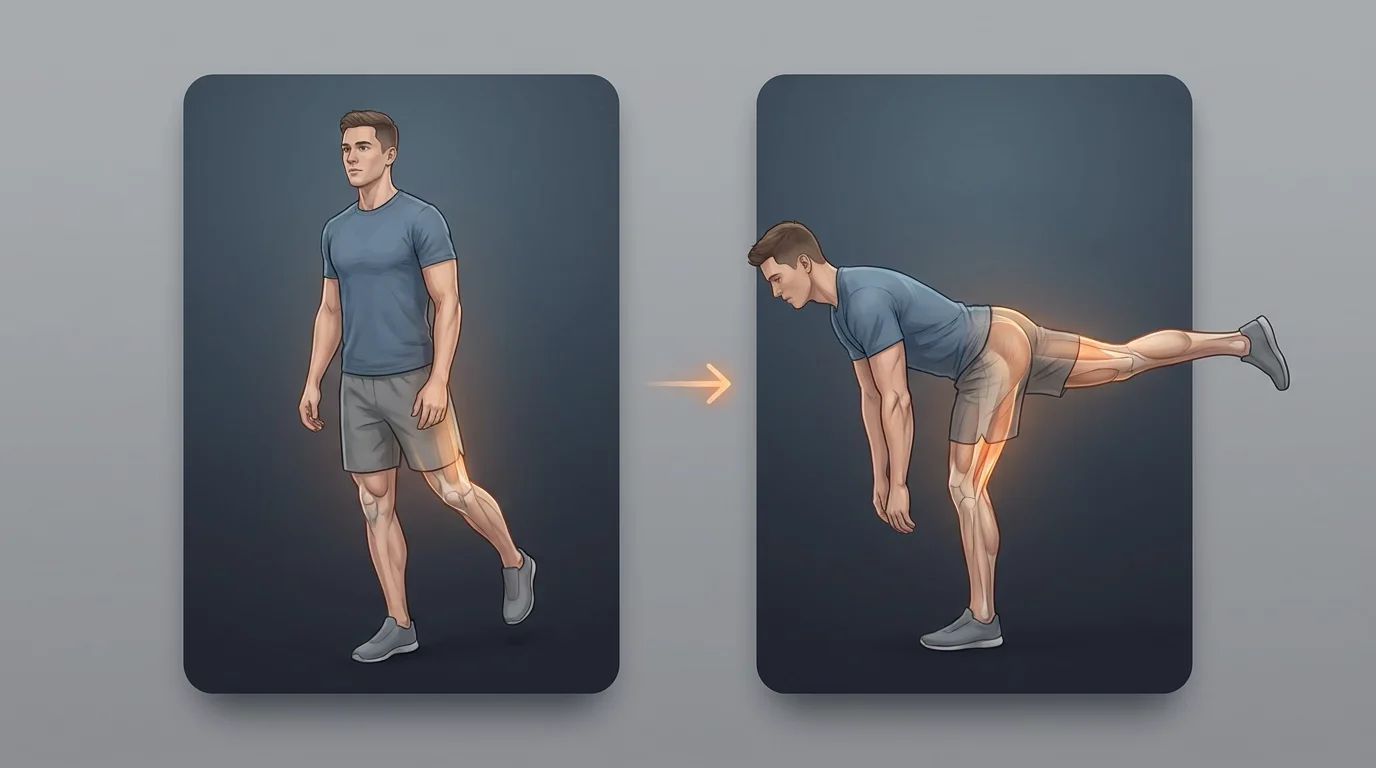
Exercise 3
Single-leg Romanian deadlift
- Dose
- 3 × 8 each side
- Muscles and task
- Glutes, hamstrings, foot and pelvic control
Watch for: Send your hips back while the free leg reaches behind. Stop before your back or pelvis turns away. Keep a slight bend in the standing knee.
Rest: 60–75 seconds after both sides.
Make it easier: Touch a wall with one hand or keep the toes of the free foot on the floor behind you.
Block B: lateral work, calves and a hold
Do the three exercises in sequence. Rest 30 seconds between exercises and 75 seconds after the wall hold, then repeat the round once. The wall hold trains local strength endurance; it does not simulate a ski run.
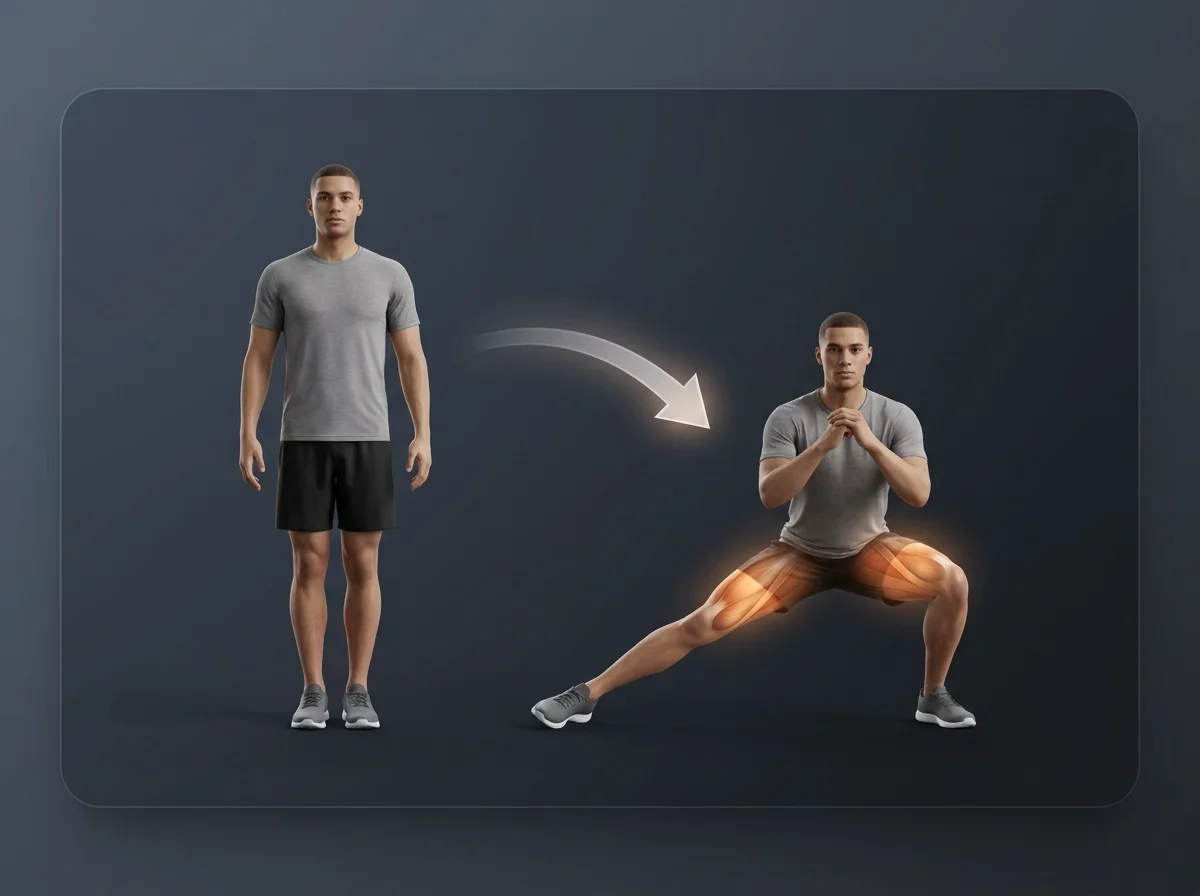
Exercise 4
Side lunge
- Dose
- 2 × 8 each side
- Muscles and task
- Quadriceps, glutes, adductors and lateral movement
Watch for: Send your hips back over one leg while the other foot stays planted. Push through the whole working foot to return to the middle.
Rest: 30 seconds, then move to the calf raise.
Make it easier: Take a shorter step, use less depth or hold a support.
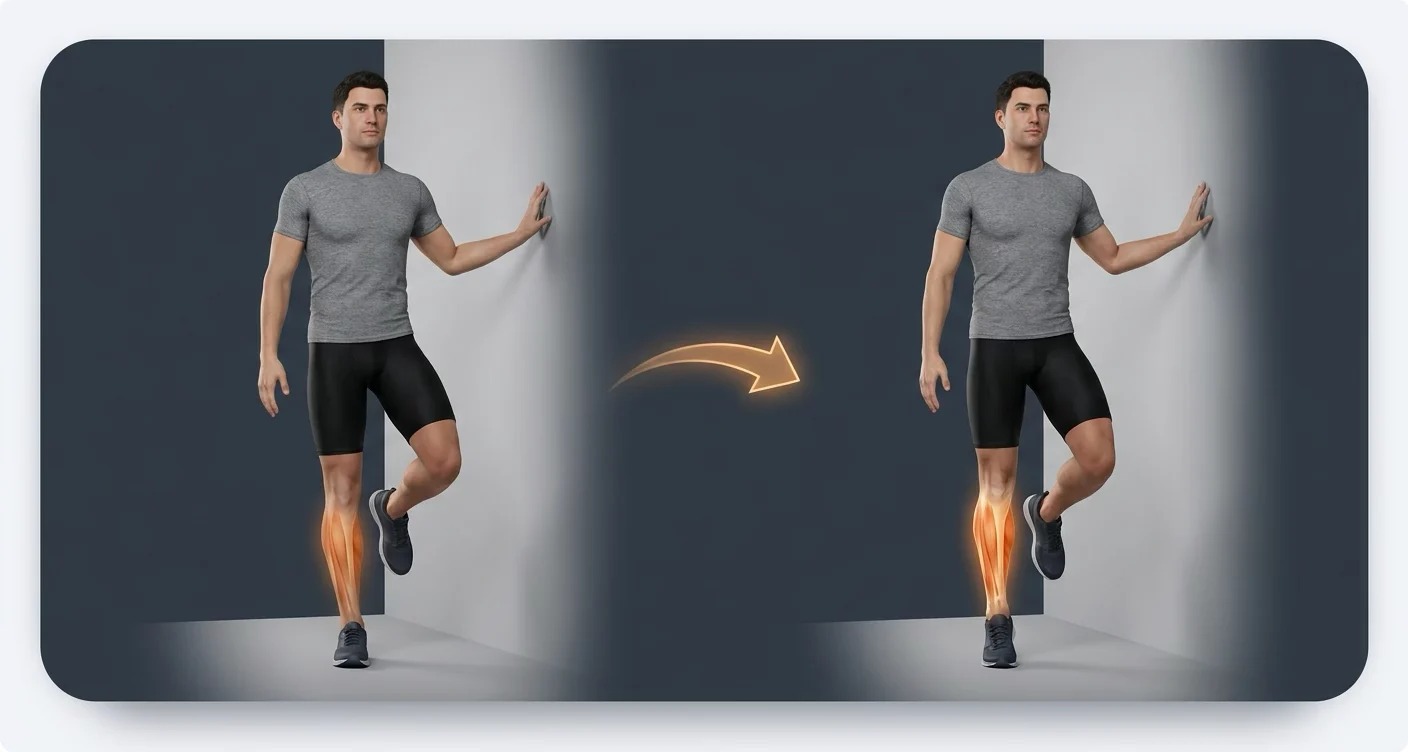
Exercise 5
Single-leg calf raise
- Dose
- 2 × 10–12 each side
- Muscles and task
- Calf, foot and ankle
Watch for: Press evenly through the ball of the foot, lift the heel smoothly and lower fully. Use the support only for balance.
Rest: 30 seconds, then move to the wall hold.
Make it easier: Use both legs or reduce the height.
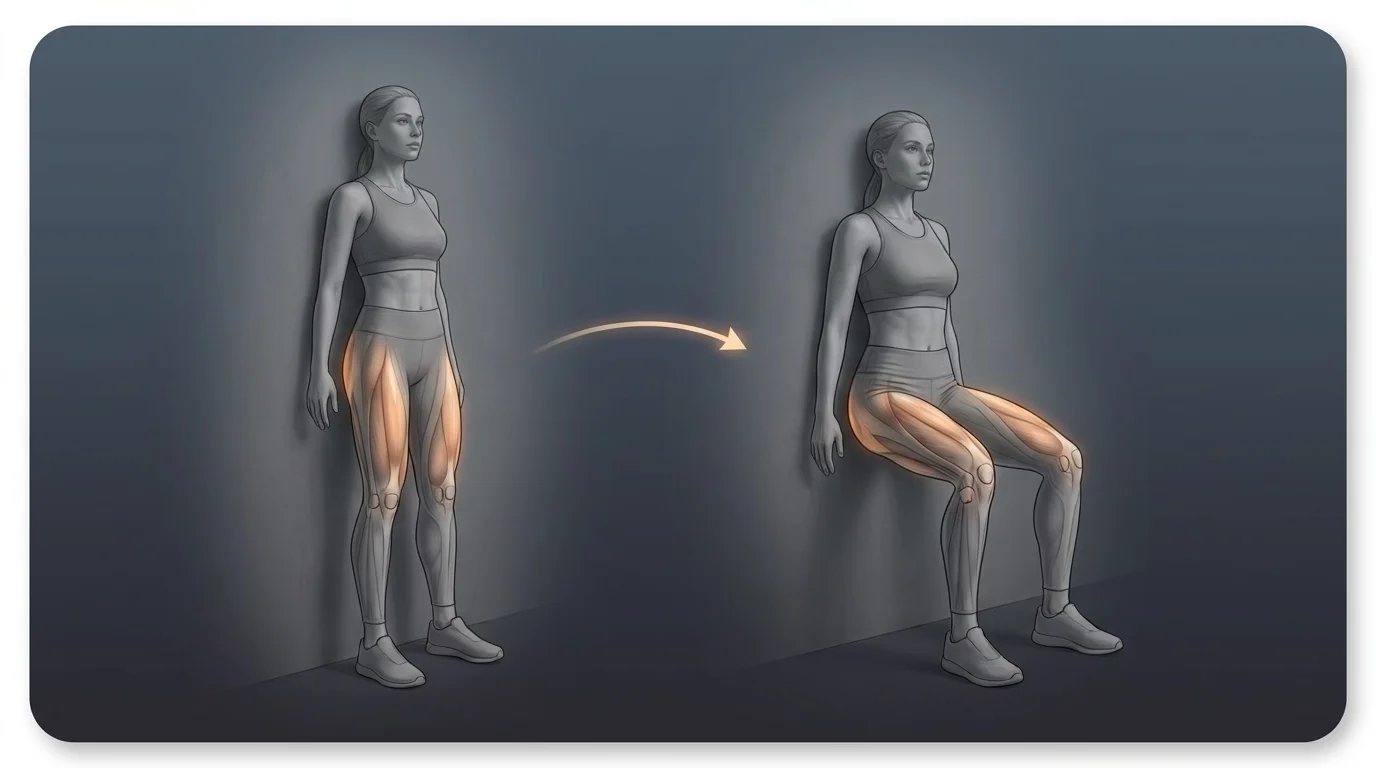
Exercise 6
Wall squat hold
- Dose
- 2 × 20–40 seconds
- Muscles and task
- Isometric strength endurance of the quadriceps and glutes
Watch for: Choose a height where your feet and knees stay quiet and you can keep breathing. Stop before you need to push on your thighs with your hands.
Rest: 75 seconds, then begin the second round.
Make it easier: Stay higher on the wall or hold for only 15–20 seconds.
Change one variable per session
If every set stays controlled, choose exactly one change for the next session. Leave the other variables alone.
Add one repetition
Add one rep per side to the step-down, lunge or Romanian deadlift.
Add a small load
Use a light backpack or small dumbbells. Keep the sets and reps unchanged.
Increase the range
Raise the step or move deeper only while the pelvis, knee and foot remain controlled.
Hold five seconds longer
Extend only the wall hold. End it before technique breaks down.
Add one set or round
Extend either one main exercise or the finishing circuit, rather than the whole workout at once.
How often to use the workout
Count every other lower-body session towards your weekly leg load. This is a template, not an automatic extra workout to stack on top of your current plan.
You already train your legs
Use this session once a week or replace a similar lower-body workout with it.
This is your main leg training
Up to two non-consecutive sessions is a general option. Progress only one of the two sessions at a time.
Five ways to make the session harder without making it better
More exhaustion does not automatically mean better preparation. These choices turn controlled work into a test of survival.
- Turning Block A into a circuit
Short transitions reduce recovery and often cost you tempo and balance on the more technical exercises.
- Starting with a high step
The step sets the range. Begin low, then raise it only when the pelvis and standing foot stay quiet.
- Adding load, reps and depth together
You will not know which change cost you control. Change one variable.
- Holding the wall squat until you slide down
The target time ends before technical failure. Burning is not a quality score.
- Ignoring other leg training
Running, cycling, lifting and hill walking also load your legs. Plan the whole week.
What the evidence supports, and what remains an editorial choice
Alpine skiing repeatedly loads the lower-limb muscles. Small recreational-skiing studies describe changing muscle activity across a ski day and lower eccentric strength measurements after several hours. They do not identify one ideal exercise. Turnbull, Kilding and Keogh (2009): physiology of alpine skiing, Koller et al. (2015): eccentric strength after four hours of recreational skiing, Hermann et al. (2023): muscle fatigue across a recreational ski day
Among ski racers, higher critical force was associated with several performance measures. The cross-sectional study shows an association, not causation or target values for recreational skiers. Chollet et al. (2026): critical force in alpine ski racers
General resistance-training evidence supports progressive work for strength, local muscular endurance and balance in healthy adults. Reaching momentary muscle failure is not consistently necessary. Warm-up research supports preparatory movement before physical performance. American College of Sports Medicine (2026): resistance training for healthy adults, Grgic et al. (2022): resistance training to muscle failure, Fradkin, Zazryn and Smoliga (2010): warm-up and physical performance
No source tests these exact six exercises, their order, rest periods or repetitions as one ski workout. The session is an editorial template; Ski Austria provided an additional comparison for accessible winter-sport exercise families. Ski Austria: Fit for winter
Place the session within your ski preparation
Why your thighs burn while skiing
Separate the feeling of burn from measured fatigue and possible technique factors.
Read the thigh-burn explainerA no-equipment alternative
Use a quieter whole-body session when you do not have a stable step.
Open the no-equipment workoutWhich muscle groups ski conditioning should cover
See how legs, hips, trunk, balance and endurance fit together.
Read the full ski-gymnastics guidePlan two or three training days
Distribute strength, endurance and recovery across a real week.
Open the weekly planProgress across eight weeks
Put this session inside a longer build instead of adding more at random each week.
Open the eight-week planDiscuss the adjustment with the AI coach
In SlopeReady, you can ask the AI coach where this session fits in your saved plan. It can use your profile, confirmed plan, recent workout summaries and available Apple Health recovery signals as context.
The coach can propose moving or shortening the session, or replacing an exercise with a suitable catalogue option. You see a lasting plan change before you confirm it. The coach does not observe your movement and knows only the context available inside the app.
SlopeReady reads the Apple Health data you allow for analysis and planning support. It does not write to Apple Health, start a live workout session, or record workouts, live heart rate or GPS routes.
Product behaviour checked against the current SlopeReady code on 12 August 2026. Terms of Use, Privacy Policy