

Choose your weekly structure first
Two sessions make up the full core. Add the third session only if it does not compete with the rest of your training.
Two sessions
Do session A and B with at least one day without strength work between them. For example, Tuesday and Saturday.
Three sessions
Put an easy, familiar endurance session between A and B. Drop it first when your week gets tight.
You already train
Replace similar lower-body sessions. Count running, cycling, hiking, team sports, and heavy leg training too.
The movements are new
In week 1, use support, a smaller range of motion, and two sets. You do not need added weight.
The eight-week calendar
The weekdays are examples. Keep the order A - optional C - B instead of squeezing missed sessions together.
Week 1
Learn the movements for example, Tuesday · Thursday · Saturday- Session A
- Session A · 2 sets per exercise
- Session C · optional
- 20-30 min. of easy, familiar endurance work
- Session B
- Session B · 2 sets per exercise
- Focus
- Find versions you can control without rushing. No added weight and no repetitions to complete failure.
Week 2
Set the rhythm for example, Tuesday · Thursday · Saturday- Session A
- Session A · 2 sets
- Session C · optional
- 25-35 min. of easy, familiar endurance work
- Session B
- Session B · 2 sets
- Focus
- Repeat the same versions. If every repetition stays controlled, use the top end of the repetition range for one exercise.
Week 3
Add volume for example, Tuesday · Thursday · Saturday- Session A
- Session A · 3 sets
- Session C · optional
- 30-40 min. of easy, familiar endurance work
- Session B
- Session B · 3 sets
- Focus
- Increase only the number of sets. Keep the range of motion, tempo, and added weight the same as in week 2.
Week 4
Settle into the work for example, Tuesday · Thursday · Saturday- Session A
- Session A · 3 sets
- Session C · optional
- 30-40 min. of easy, familiar endurance work
- Session B
- Session B · 3 sets
- Focus
- Repeat week 3. If you cannot hold a stable position, choose the easier version instead of adding work.
Week 5
Change one variable for example, Tuesday · Thursday · Saturday- Session A
- Session A · 3 sets · one small increase
- Session C · optional
- 35-45 min. of easy, familiar endurance work
- Session B
- Session B · 3 sets · one small increase
- Focus
- In both A and B, change only one exercise: one repetition, a little more range of motion, five seconds of hold time, or a light load.
Week 6
Repeat the increase for example, Tuesday · Thursday · Saturday- Session A
- Session A · same as week 5
- Session C · optional
- 35-50 min. of easy, familiar endurance work
- Session B
- Session B · same as week 5
- Focus
- Confirm the versions you chose. Do not add a second increase just because one session felt easy.
Week 7
Reduce volume adapt it to travel and recovery- Session A
- Session A · 2 sets
- Session C · optional
- 20-30 min. easy or skip it
- Session B
- Session B · 2 sets
- Focus
- Use familiar versions only. No new load, larger range of motion, jump series, or max test.
Week 8
Arrive fresh only with your usual recovery gap- Session A
- One brief, familiar session · 2 sets
- Session C · optional
- Easy walking or familiar, very light movement
- Session B
- A brief second session or skip it
- Focus
- Do not make up missed work. Skip the second session if you cannot keep your normal gap before travel or your week is already full.
Before A and B: prepare for 5-8 minutes
Use calm, familiar movements. Before the first two main exercises, do one easy practice set with a smaller range of motion.
-
60-90 sec.
Brisk walk or march
Increase the pace until you can still speak normally.
-
8 reps
Squat to a step
Touch the step lightly, then stand back up with control.
-
6 per side
Shallow reverse lunge
Step one foot back briefly, then return to standing without momentum.
-
8 reps
Hip hinge
Push your hips back, keep your back long, then stand up again.
-
8 reps
Calf raise
Lift your heels steadily, then lower them all the way.
Session A: controlled deceleration and posterior chain
Finish every set of an exercise before moving on. Work without time pressure and end the set while you can still control each repetition.
Exercise 1
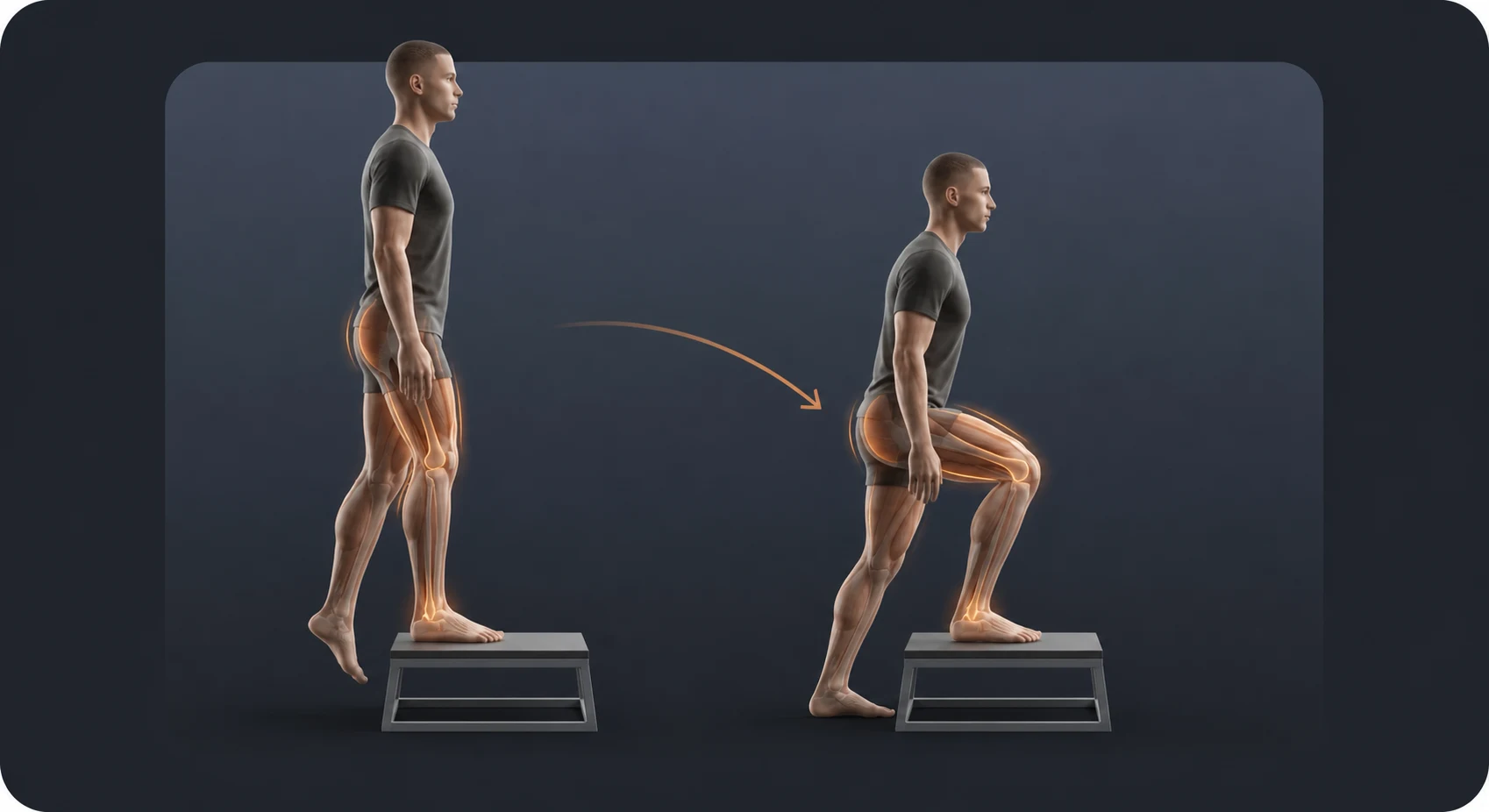
Eccentric step-down
- Volume
- 2-3 × 6 per side · lower for 3 sec.
- Rest
- 60-75 seconds after both sides.
Focus on: Place your whole foot on the step. Lower the free heel slowly, then press back up with control. Keep your pelvis and standing foot steady.
Make it easier: Use a lower step, hold on lightly, or reduce the range of motion.
Exercise 2
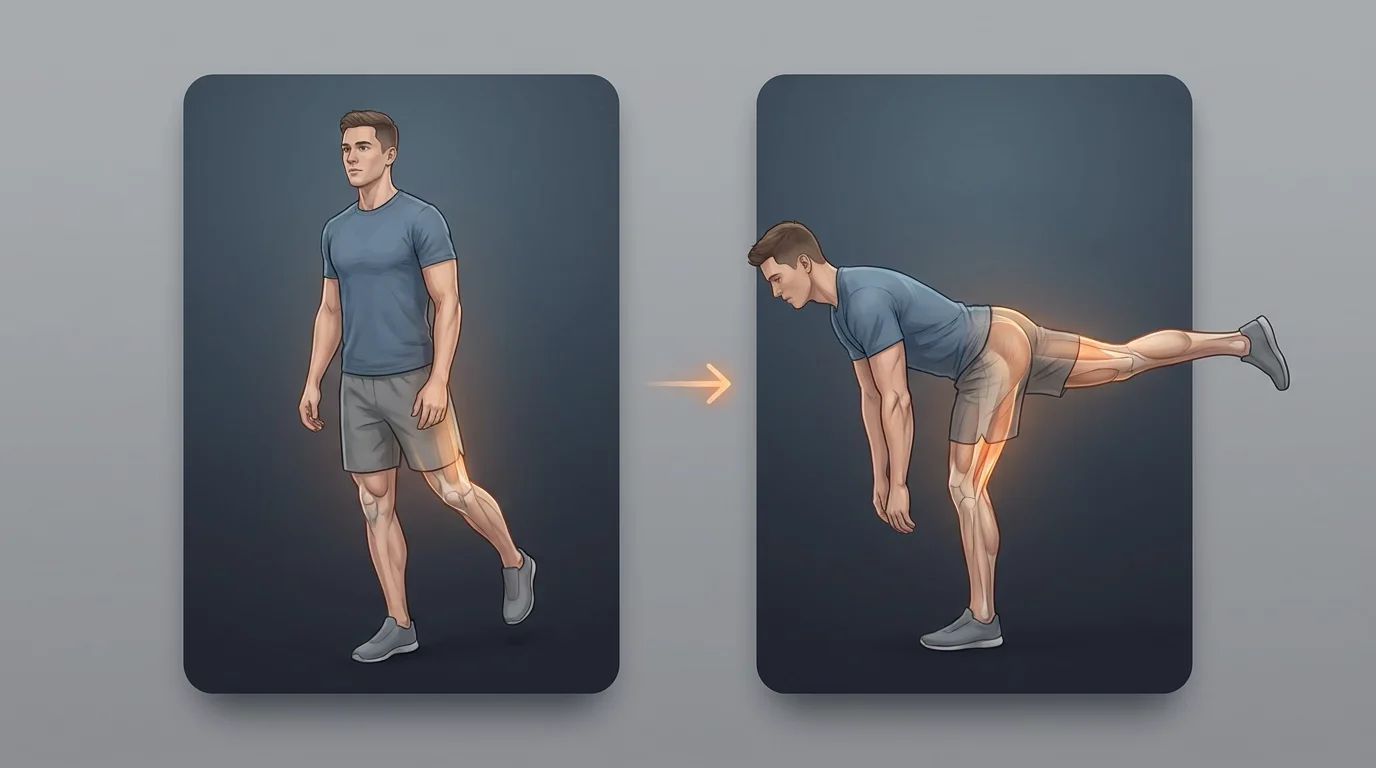
Single-leg Romanian deadlift
- Volume
- 2-3 × 6 per side
- Rest
- 60-75 seconds after both sides.
Focus on: Push your hips back and extend the free leg behind you. Stop before your back or pelvis shifts.
Make it easier: Rest the toes of your free foot behind you or touch a wall.
Exercise 3
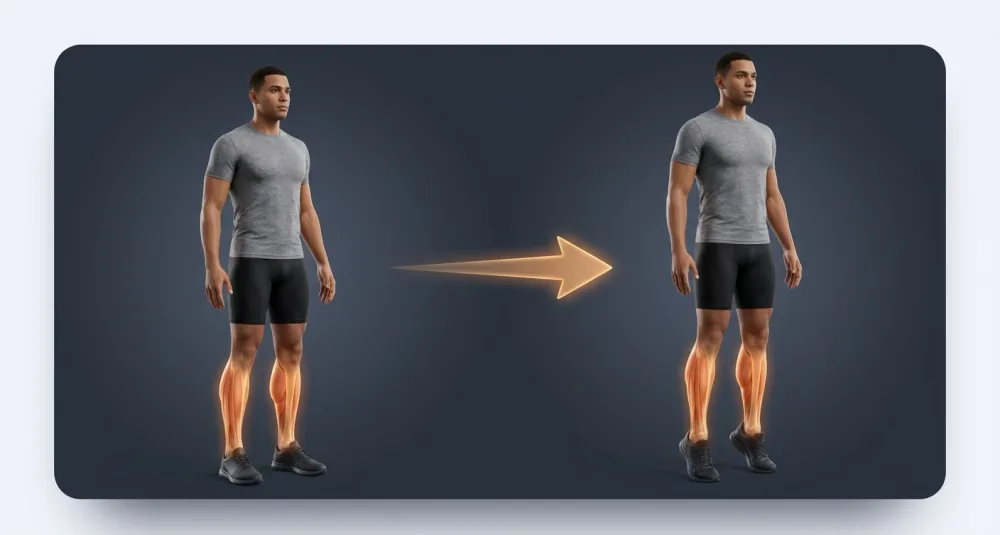
Calf raise
- Volume
- 2-3 × 10-12 repetitions
- Rest
- 45-60 seconds.
Focus on: Lift your heels steadily, pause briefly at the top, and lower them all the way. Do not let your ankles roll outward.
Make it easier: Hold on to a wall or start with both legs.
Exercise 4
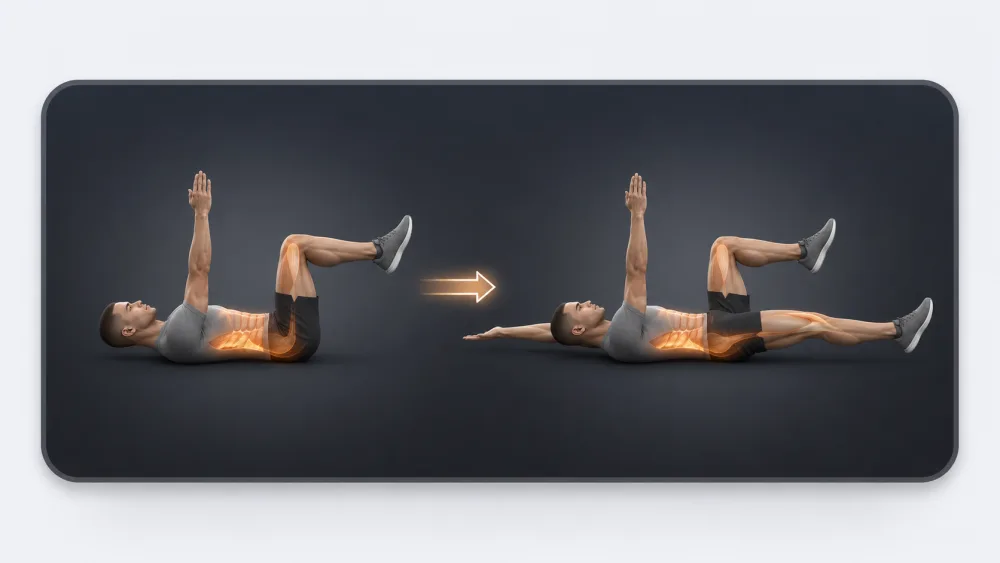
Dead bug
- Volume
- 2-3 × 6 per side
- Rest
- 45-60 seconds.
Focus on: Keep your lower back still. Extend the arm and opposite side slowly, and keep breathing.
Make it easier: Touch only your heel to the floor or move only your legs at first.
Session B: lateral control and strength endurance
Put the movements that demand more coordination first. The wall sit comes later and does not replace clean form in the dynamic exercises.
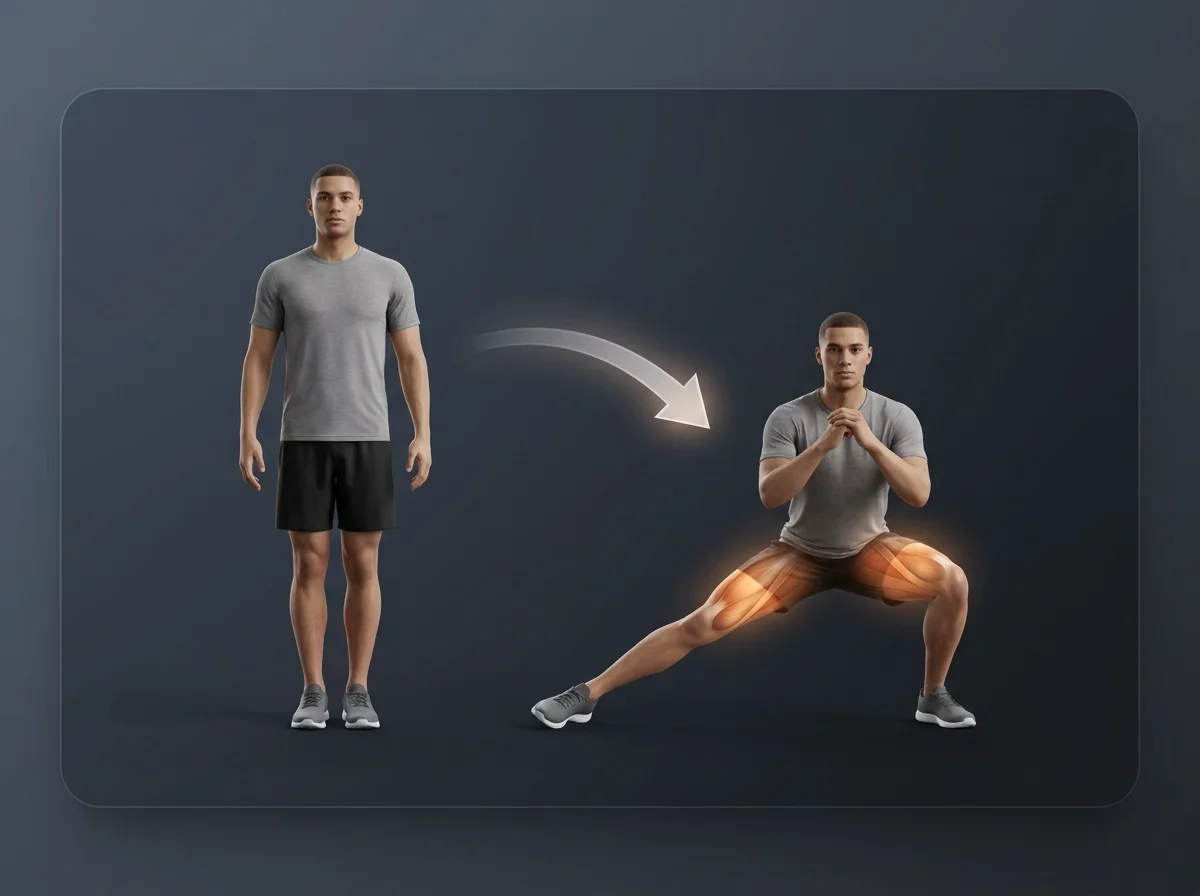
Exercise 1
Lateral lunge
- Volume
- 2-3 × 6 per side
- Rest
- 60-75 seconds after both sides.
Focus on: Push your hips back over one leg. Press through the whole working foot to return to the middle.
Make it easier: Use a smaller step and less depth, or hold on to support.
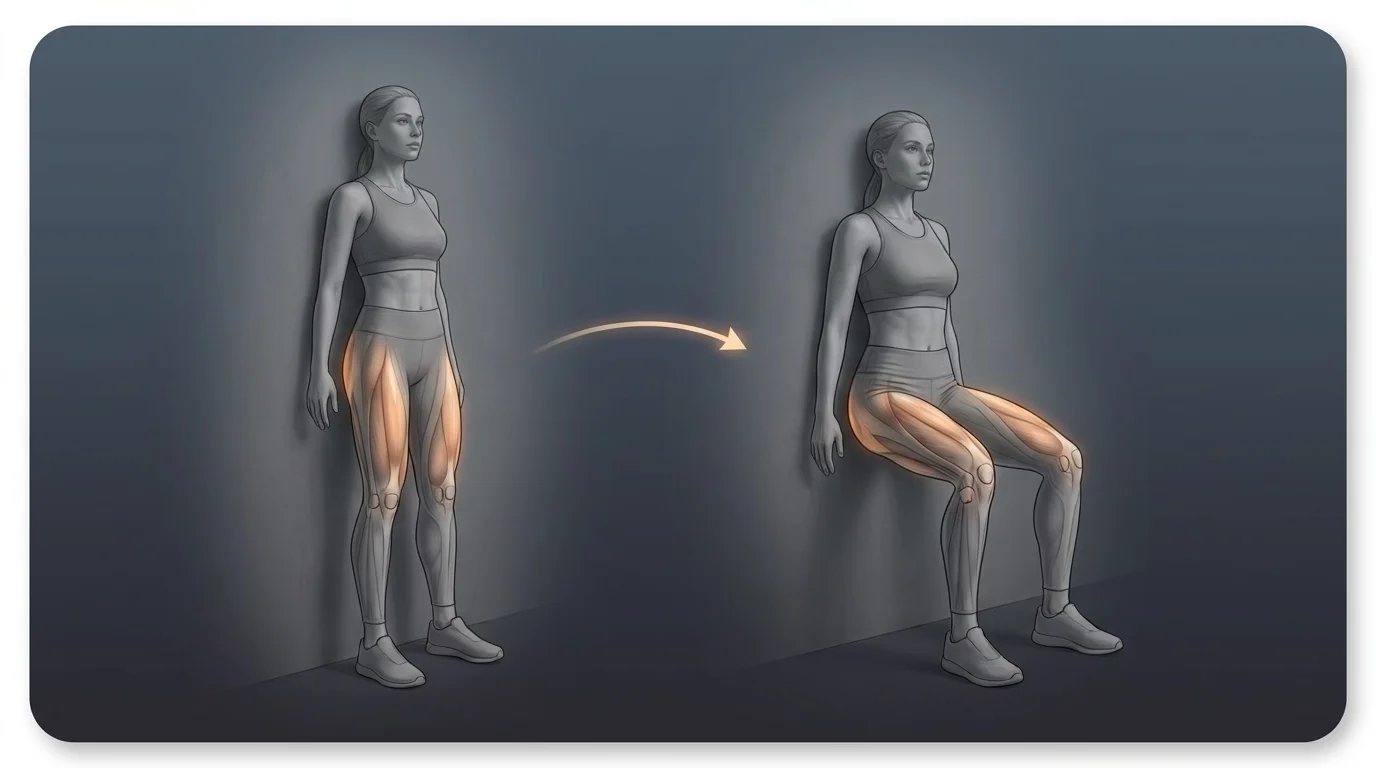
Exercise 2
Wall sit
- Volume
- 2-3 × 20-40 seconds
- Rest
- 60 seconds.
Focus on: Choose a height where your feet and knees stay steady and you can keep breathing. End the hold before you need to brace yourself with your hands.
Make it easier: Slide down less far or hold for 15-20 seconds.
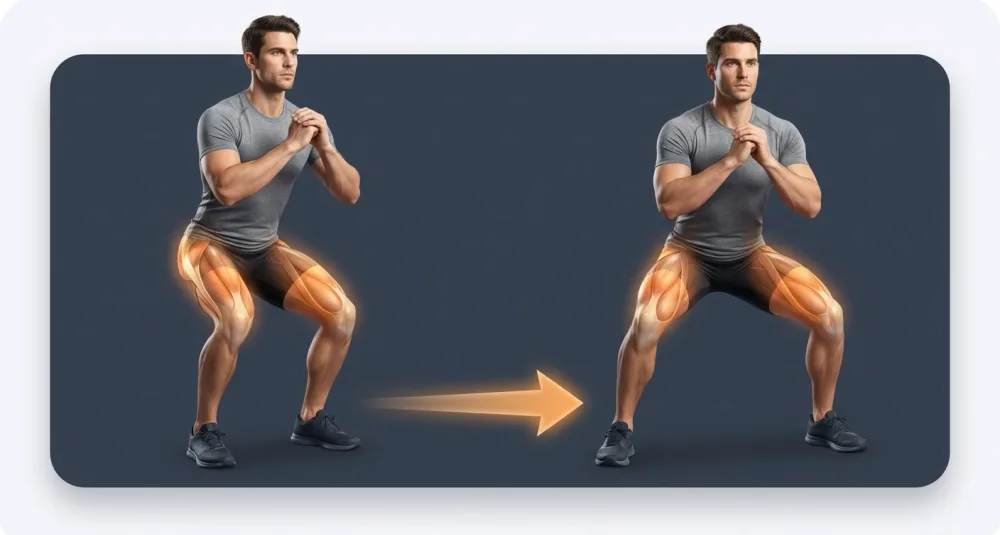
Exercise 3
Lateral steps in a shallow squat
- Volume
- 2-3 × 10-16 steps total
- Rest
- 45-60 seconds.
Focus on: Stay in a shallow squat. Place each foot with control, and point your knees and toes in the same direction.
Make it easier: Stand taller and take fewer or smaller steps.
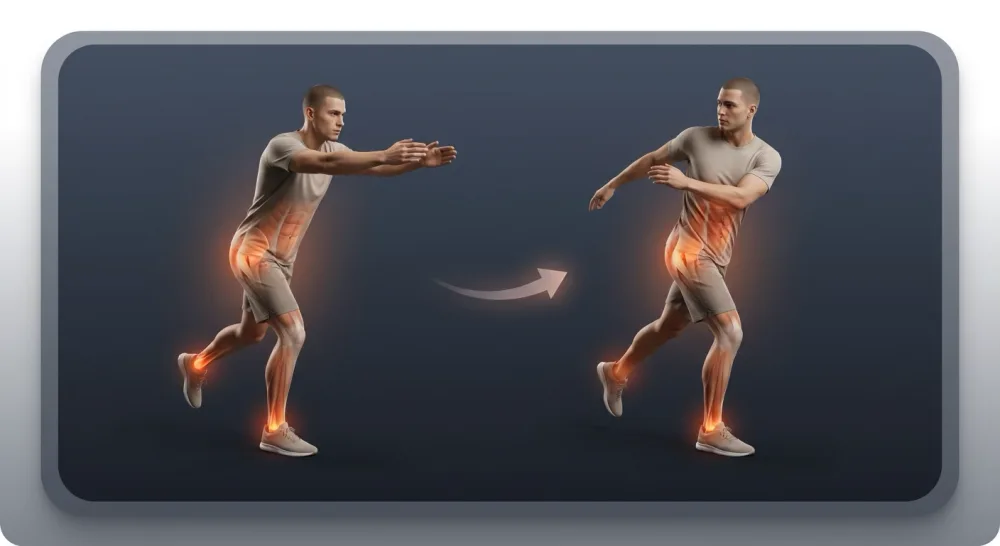
Exercise 4
Single-leg balance with torso rotation
- Volume
- 2-3 × 5 rotations in each direction per side
- Rest
- 45 seconds after both legs.
Focus on: Keep a slight bend in your standing knee. Turn your chest slowly and return to the middle after each rotation.
Make it easier: Touch the wall with one finger and make the rotation smaller.
Increase exactly one thing
More work counts as progress only when you can control the movement. Choose no more than one of these four options per session:
Add one repetition
Use the top end of the range for one exercise. Leave the other exercises unchanged.
Add a little load
Use a light backpack or small dumbbells for one controlled exercise. Keep the repetitions and sets the same.
Increase the range of motion
Increase the step height or depth only as far as your pelvis, knee, and foot stay steady.
Hold for five more seconds
Extend only the wall sit. Still finish before you lose the position.
If you miss a session
A complete table is not the goal. Keep the order and the purpose of the week:
Do not double up
Do not make up A or B the next day if that puts two strength sessions back to back.
Drop the optional session first
Leave out session C and do the next strength session in its planned order.
Do not extend the plan
A missed session does not automatically move into week 7 or 8. Continue with the next scheduled session.
Note why it happened
Briefly note why you missed the session. That helps more than a calendar that looks perfect in hindsight.
What the evidence supports and what remains editorial planning
Research on alpine skiing describes the link between technical control, muscular work, and several energy systems. The review focuses mainly on racing, while the study by Koller and colleagues examined 24 healthy, fit recreational skiers after four hours of skiing. Turnbull, Kilding and Keogh (2009): physiology of alpine skiing, Koller et al. (2015): strength after four hours of recreational skiing
The ACSM review supports progressive strength training for healthy adults. Its included interventions lasted at least six weeks. Voluntary strength gains benefited from two or three sets and at least two sessions per week. That does not prove this exercise selection or calendar. American College of Sports Medicine (2026): strength training for healthy adults
You can combine strength and endurance in one program. Training to muscular failure is not required. Warm-up research supports preparatory movement, but does not test these exact five steps. Grgic et al. (2022): training to muscular failure, Huiberts et al. (2024): combined strength and endurance training, Fradkin, Zazryn and Smoliga (2010): warm-up and physical performance
No source tests this eight-week calendar, its exercises, repetitions, rest periods, progression rules, or final phase as a package. Research on tapering in competitive athletes and Suva's exercise selection do not directly confirm it. Bosquet et al. (2007): tapering in competitive athletes, Suva: fitness exercises for winter sports
Choose the next step
Put your whole preparation in context
See how strength, endurance, control, mobility, and recovery fit together.
Read the conditioning guideCompare exercises by training purpose
Look up variations and uses without turning the catalogue into a second training plan.
Go to the exercise catalogueOnly four weeks left?
Use the shorter calendar if the eight-week starting point has already passed.
Go to the 4-week planOrganize two or three sessions
Explore the weekly structure if your calendar is the limiting factor.
Go to weekly planningTrain without a step
Switch to a calm, equipment-free session if you do not have what A or B needs.
Go to the home workoutUnderstand recovery days
Tell the difference between complete rest, easy movement, and real training sessions.
Read the recovery guideDiscuss plan changes with the AI Coach
With your permission, the AI Coach can use the Apple Health data you allow together with your saved plan as context. You review lasting plan changes before confirming them.
SlopeReady does not record workouts, GPS routes, or ski technique.
Product behavior checked in the current SlopeReady code on August 12, 2026. Terms of use, Privacy policy