
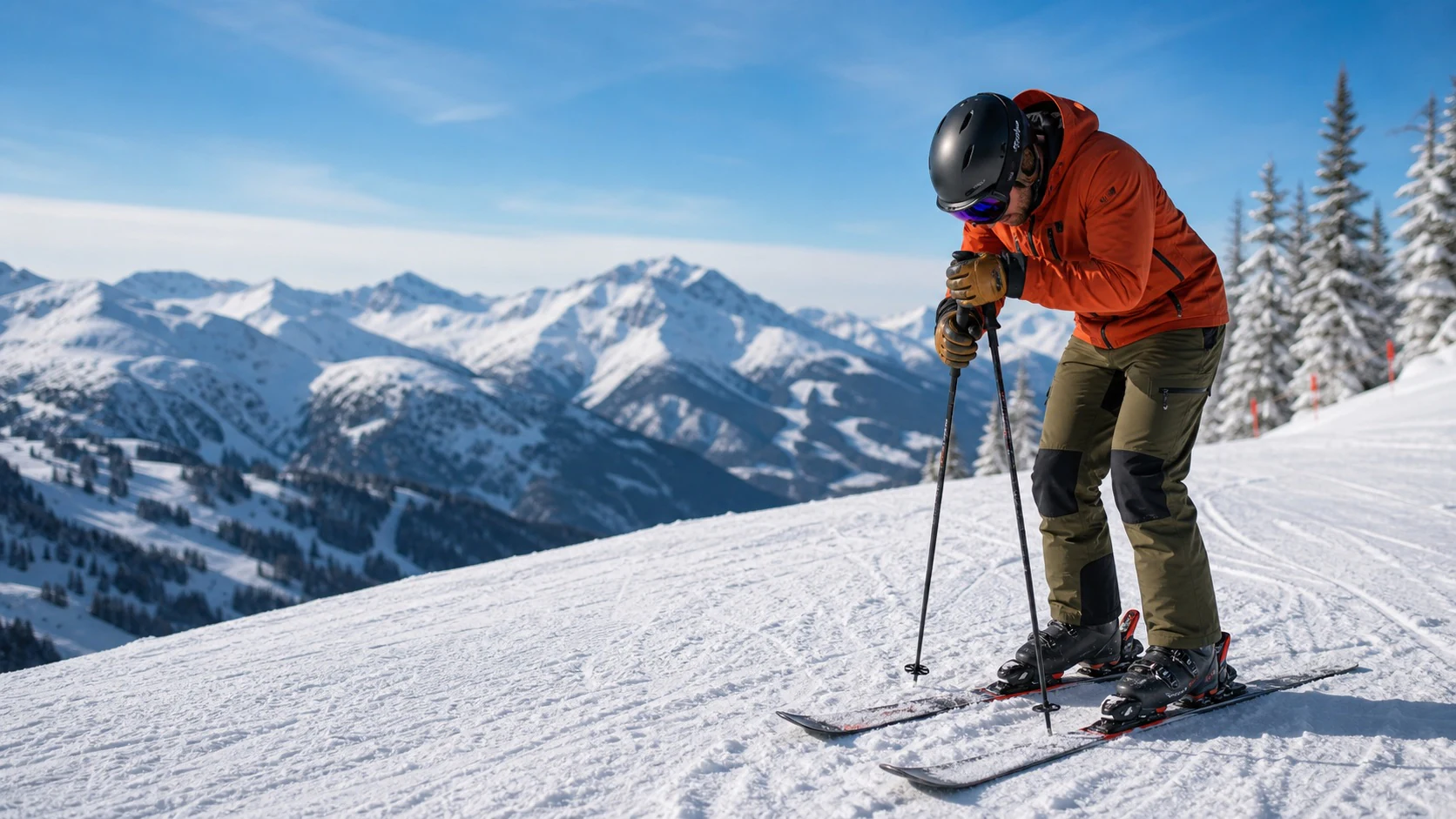
Thigh burn while skiing usually appears when the muscles work hard again and again. The sensation probably arises from a combination of signals from the working muscles. Burning alone cannot reveal the exact cause.
It does not prove “lactic acid buildup,” weak legs, one technique fault or the need for a particular exercise. In an experiment with 10 volunteers, individual substances such as lactate caused no fatigue or pain sensation; combinations of protons, lactate and ATP did. The researchers infused a thumb muscle, not a skier’s thigh, so the study describes one possible mechanism behind the sensation, not a complete explanation for thigh burn while skiing.
What to notice before drawing conclusions
Intensity is useful information, but it is not enough by itself. Also note when the burn starts, how long it lasts, whether the two sides differ, the terrain and snow, what a pause changes, and whether the pattern repeats from run to run.
| What you notice | What may fit | What it cannot establish | A sensible next step |
|---|---|---|---|
| Both thighs gradually burn on a long run, then settle after a pause. | Intense, repeated muscle work and rising local fatigue fit this pattern. | It does not establish “acid buildup” or weak legs. | Note the run length, terrain, intensity and recovery before the next run. Compare the pattern across several runs. |
| The burn starts early on easy terrain. | Muscles working hard for a long time, movement that is unfamiliar to you, or a boot that restricts movement are possible explanations. | The sensation does not establish a back-seat stance or poor boot fit. | Ask a qualified instructor to observe your movement. Have the boots checked if you also notice pressure, numbness or restricted movement. |
| One side repeatedly burns earlier or more strongly. | The inside and outside legs work differently. Turn direction, terrain, movement and equipment may contribute to a persistent side difference. | This does not diagnose a muscle imbalance or injury. | Compare both turn directions over several runs. If the pattern persists, ask an instructor to assess your movement and a boot-fitting specialist to check your boots. |
| You feel sharp or joint-centred pain, or develop numbness or weakness. The symptoms worsen unusually fast or remain at rest. | This does not resemble ordinary bilateral muscle burn from exertion. | The table cannot identify its cause. | Stop the run and seek prompt medical assessment. Call emergency services if weakness or numbness starts suddenly, follows a head, neck or back injury, or comes with trouble speaking, walking or confusion. |
The emergency signs in the last row come from guidance by MedlinePlus on numbness and weakness and the NHS on warning signs after a head injury. The table helps you choose a safe response, but it is not a self-diagnosis tool.
Why skiing puts so much work through the thighs
Forces from the snow, speed and direction change the load at the knee throughout a turn. The quadriceps produce a knee-extension moment that controls how quickly and how far the knee bends under load. They do more than hold a crouch: their task changes through the turn.
The inside and outside legs do not share the same job either. A study of seven female recreational skiers compared the activity of two parts of the quadriceps on sections with three different inclinations. Measured activity increased on steeper terrain, while the inside-outside pattern differed by muscle. The study did not measure burning, and its small sample and standardised conditions limit how widely the results can be applied. The narrower finding is that muscular demand changes with terrain and turn phase.
How repeated runs change muscle coordination
Even one turn requires muscles to alternate tension and release. Across long and repeated runs, the nervous system has to organise that task again and again. The timing, distribution and coordination of muscle activity can shift even when the skiing looks similar from the outside.
In a study of six recreational skiers completing 24 standardised runs, the frequency and timing of quadriceps activity changed between the early and late runs. The authors interpreted this as altered coordination. They did not measure burning, and six people cannot provide a universal explanation.
A 2023 study followed 38 female recreational skiers over 40 through a ski day. Sensors built into special shorts recorded the electrical activity of their muscles. After two hours of free skiing, a 45-minute lunch break and another two hours, the measurements showed signs of mounting fatigue; the break did not fully restore the values. The study did not ask about burning. Its findings also cannot be assumed to apply to men, younger skiers, athletes or every recreational skier.
Where eccentric muscle work fits
During an eccentric contraction, a muscle produces force while lengthening. The quadriceps use this action when they slow knee flexion under load. Skiing also involves holding and shortening actions, so eccentric work cannot explain every burning sensation by itself.
In one study, 24 healthy, physically fit recreational skiers, including 14 men and 10 women, skied for four hours. Researchers used isokinetic dynamometry the day before, then one hour and 24 hours after skiing. Eccentric peak torque was significantly reduced in the muscles at the back of both thighs and only in the left quadriceps; the other strength tests showed no significant changes. Torque loss measured after skiing is not the same as burning during a run.
What you can infer about technique and equipment
Deeply bent knees and a rearward position may change the load on the quadriceps. However, the studies above do not show that a particular stance necessarily causes early burning. The sensation alone cannot diagnose back-seat skiing.
Ask an instructor to watch your movement on several types of terrain and in both turn directions. Pressure points, numbness or clearly restricted movement are separate reasons to have the boots assessed. Burning by itself does not establish a fit or equipment problem.
How to use the observation in your preparation
Burning is a sensation during effort. Measured fatigue refers to changes in muscle activity or performance. A drop in torque is another measured result. Sharp or joint-centred pain and delayed muscle soreness that begins after the activity are different observations again. They may overlap, but they are not interchangeable.
Track how recurring burn changes from run to run. Do not treat it as a diagnosis or fitness score. Note when it starts, how long it lasts and what changes with terrain and rest. Those details add context to the difference between general fitness and ski-specific preparation. Include recent training and recovery as well; the guide to recovery days as part of training explains why.
If you want a practical next step, the complete ski leg workout gives you one ordered session with exact rest, easier versions and a shorter first-use option. It is a general training template, not a diagnosis or treatment for burning.
What SlopeReady can and cannot do
SlopeReady does not determine the cause of burning, assess ski technique or check your boots. It does not record a ski workout in real time. After you give permission, it reads only the available data from Apple Health.
SlopeReady helps you view your preparation, recent sessions and available recovery measures in the context of your trip. It is neither a diagnostic tool nor a live ski-run tracker.