
General conditioning and a pre-ski warm-up do different jobs
Both involve movement, but they work on very different timescales.
General session
- Time
- 35–45 minutes
- Job
- Develop strength, strength endurance, balance and movement control over several weeks.
- Practical value
- You train qualities relevant to repeated steering, stabilising and absorbing force on snow.
- Limit
- One session cannot make you ready for a full ski day.
Before the first run
- Time
- 5–7 minutes
- Job
- Raise body temperature, move joints through controlled ranges and prepare to start skiing.
- Practical value
- You avoid going straight from sitting or a long lift ride into a fast descent.
- Limit
- It does not replace strength or endurance training and cannot guarantee injury prevention.
The muscle groups you are preparing
Skiing is not only a quadriceps task. Your legs, hips and trunk work together repeatedly while you control balance and body position.
Swipe sideways to see the full table.
| Area | Training job | Exercise examples |
|---|---|---|
| Quadriceps | Control knee flexion and extension and accept load in a bent position. | Forward lunge, shallow squat |
| Glutes and hamstrings | Extend the hip, control the pelvis and load the back of the thigh. | Single-leg Romanian deadlift, lunge |
| Lateral hip and adductors | Keep the pelvis and leg alignment controlled during side-to-side movement. | Lateral squat walk |
| Calves, feet and ankles | Control small postural changes and transfer pressure through the foot. | Calf raise, single-leg balance |
| Abdominals, obliques and back | Control pelvis and ribcage while the arms and legs move. | Dead bug, controlled trunk rotation |
| Cardiovascular system | Support repeated work over a longer period. | Cycling, brisk walking or another familiar easy endurance activity |
Quadriceps
Control knee flexion and extension and accept load in a bent position.
Exercise examples: Forward lunge, shallow squat
Glutes and hamstrings
Extend the hip, control the pelvis and load the back of the thigh.
Exercise examples: Single-leg Romanian deadlift, lunge
Lateral hip and adductors
Keep the pelvis and leg alignment controlled during side-to-side movement.
Exercise examples: Lateral squat walk
Calves, feet and ankles
Control small postural changes and transfer pressure through the foot.
Exercise examples: Calf raise, single-leg balance
Abdominals, obliques and back
Control pelvis and ribcage while the arms and legs move.
Exercise examples: Dead bug, controlled trunk rotation
Cardiovascular system
Support repeated work over a longer period.
Exercise examples: Cycling, brisk walking or another familiar easy endurance activity
Why exercise order matters
This order is not a law of nature. It is a practical choice: start with work that needs attention and clean control, then move to smaller assistance work and easy mobility.
-
1. Get warm
Move for 5–8 minutes until you feel warmer while breathing comfortably. Then rehearse the first movements through a small range.
-
2. Balance and coordination
Practise the single-leg task while you are fresh. Use a wall for light support instead of turning every wobble into a strength test.
-
3. Main leg movements
The lunge and hip hinge need the most control. Give them time and keep the planned rest.
-
4. Lateral stability, calves and trunk
Add hip, lower-leg and trunk work after the main movements. Quality still matters more than speed.
-
5. Finish calmly
End with a few controlled mobility cycles. Long static holds are not the main part of a warm-up immediately before performance.
A complete general session
Treat this as a starting template, not a test you must pass. Use a stable wall or chair. Move slowly enough to control your position and breathing.
How the 35–45 minutes fit together
These times include the planned rests and normal transitions between exercises. Do not rush a controlled repetition just to stay on schedule.
-
5–8 min
Warm-up
Raise your temperature, move the main joints and rehearse two patterns.
-
3–4 min
Balance
Single-leg balance with trunk rotation, including the short rests.
-
14–16 min
Main leg movements
Forward lunges and single-leg hip hinges with the full set rests.
-
10–12 min
Supporting work
Train the lateral hip, calves and trunk in sequence.
-
3–5 min
Mobility and transitions
Finish calmly and allow time to set up, drink and move between exercises.
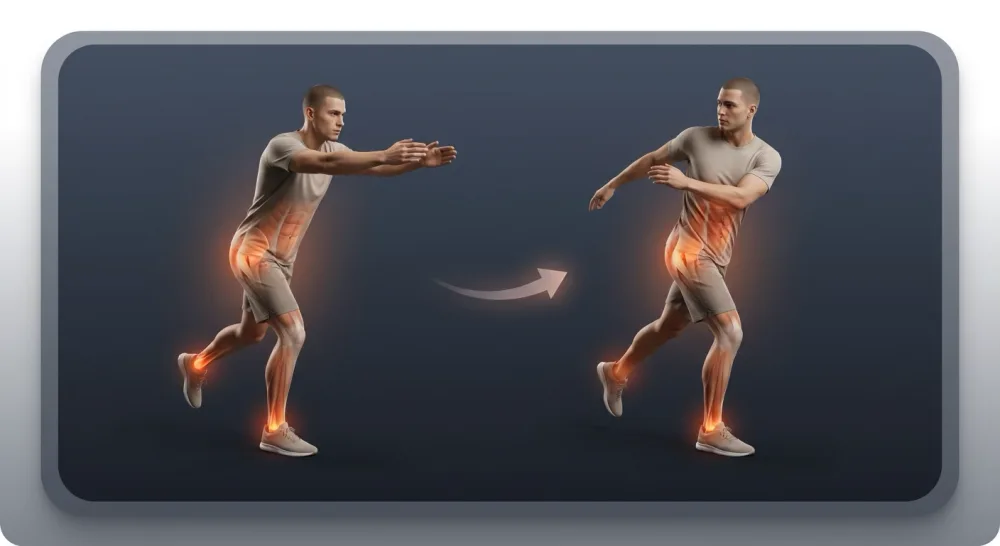
Exercise 1
Single-leg balance with trunk rotation
- Dose
- 2 × 5 turns each way on each leg
- Rest
- 45 seconds
- Main focus
- Foot, ankle, lateral hip and trunk
Watch for: Keep a soft bend in the standing knee. Turn your ribcage slowly while the knee and foot keep pointing in the same direction. Return to centre after each turn.
Make it easier: Stand beside a wall and touch it with one finger. Reduce the rotation before you reduce your attention.
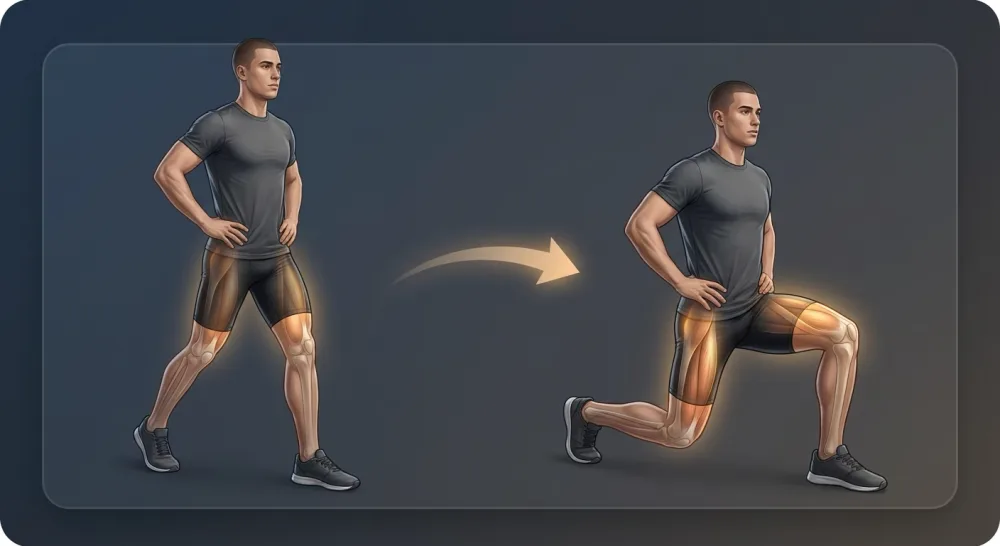
Exercise 2
Forward lunge
- Dose
- 3 × 8 each side
- Rest
- 60 seconds
- Main focus
- Quadriceps, glutes and leg alignment
Watch for: Step far enough forward, lower under control and point the front knee in the same direction as the toes. Push back through the whole front foot.
Make it easier: Use light support or reduce depth. End the set when you can no longer control the leg position.
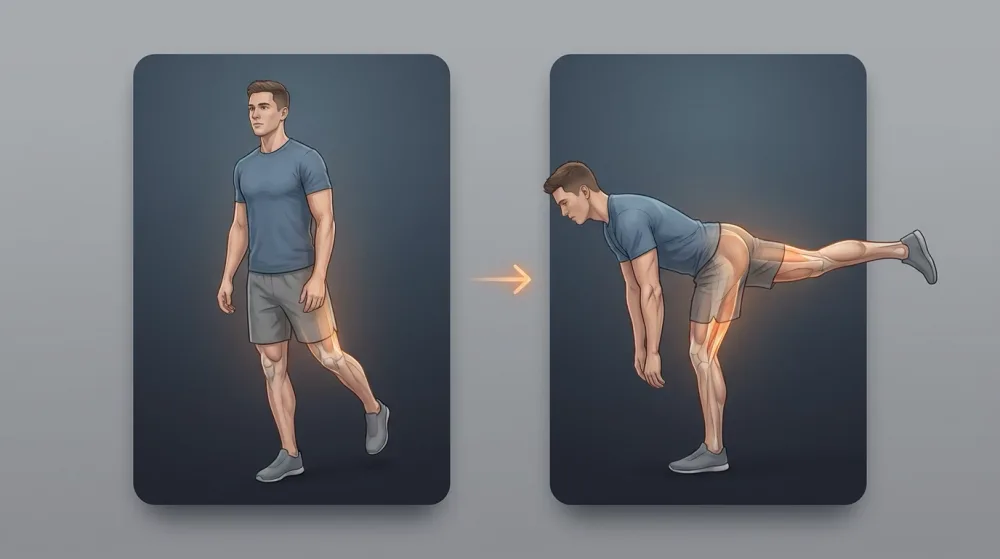
Exercise 3
Single-leg Romanian deadlift
- Dose
- 3 × 8 each side
- Rest
- 60 seconds
- Main focus
- Hamstrings, glutes, hips and balance
Watch for: Send the hips back as the free leg reaches behind you. Keep your back and pelvis quiet. Stop the range before your back rounds or pelvis opens.
Make it easier: Touch a wall or chair. Shorten the range and, if needed, rest the free toes lightly behind you.
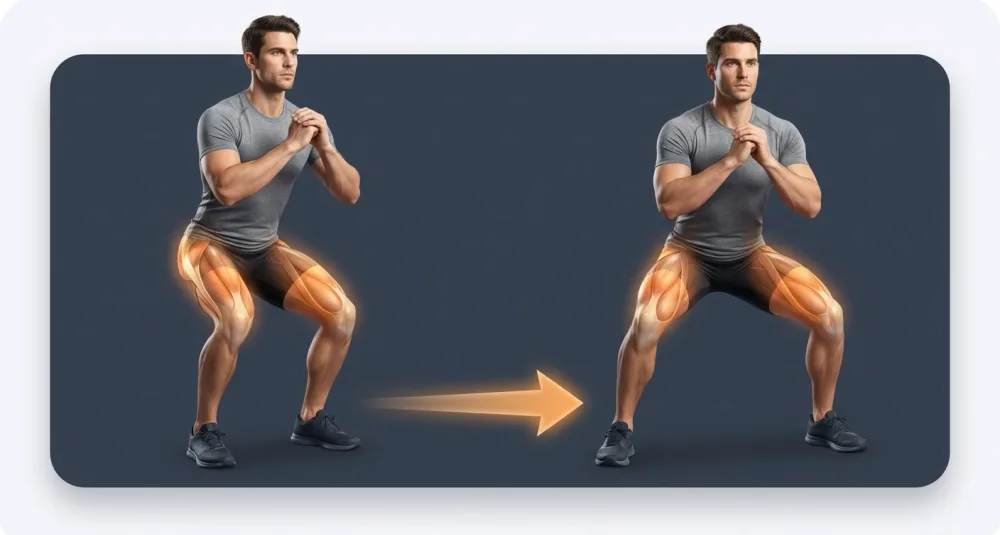
Exercise 4
Lateral squat walk
- Dose
- 2 × 8 steps each way
- Rest
- 45 seconds
- Main focus
- Lateral hip, glutes and thighs
Watch for: Stay in a shallow squat. Place each foot under control and keep knees and toes pointing the same way. Keep the upper body quiet.
Make it easier: Use a higher position and smaller steps. Leave out the mini-band to keep the movement easier.
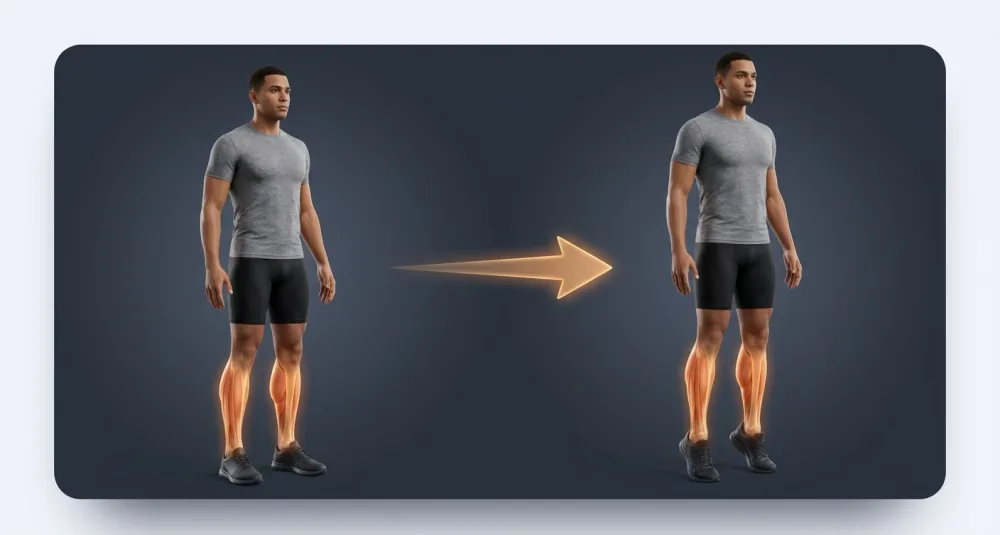
Exercise 5
Calf raise
- Dose
- 2 × 12–15
- Rest
- 45 seconds
- Main focus
- Calves, feet and ankles
Watch for: Lift both heels smoothly, pause briefly and lower slowly. Spread pressure across the forefoot without letting the ankles roll out.
Make it easier: Hold a wall and stay on two legs. Add height or a single-leg version only later.
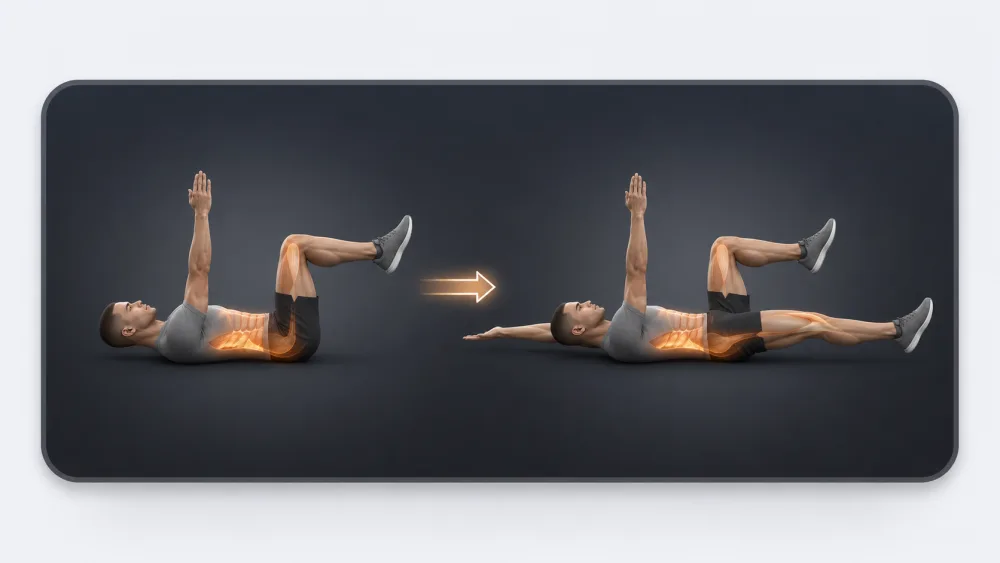
Exercise 6
Dead bug
- Dose
- 2 × 8 each side
- Rest
- 45 seconds
- Main focus
- Abdominals and control of pelvis and ribcage
Watch for: Keep your lower back quiet against the floor and slowly reach one arm and the opposite leg. Keep breathing. Stop the reach before your back lifts.
Make it easier: Tap one heel down or move only the legs. A smaller range is better than arching your back.
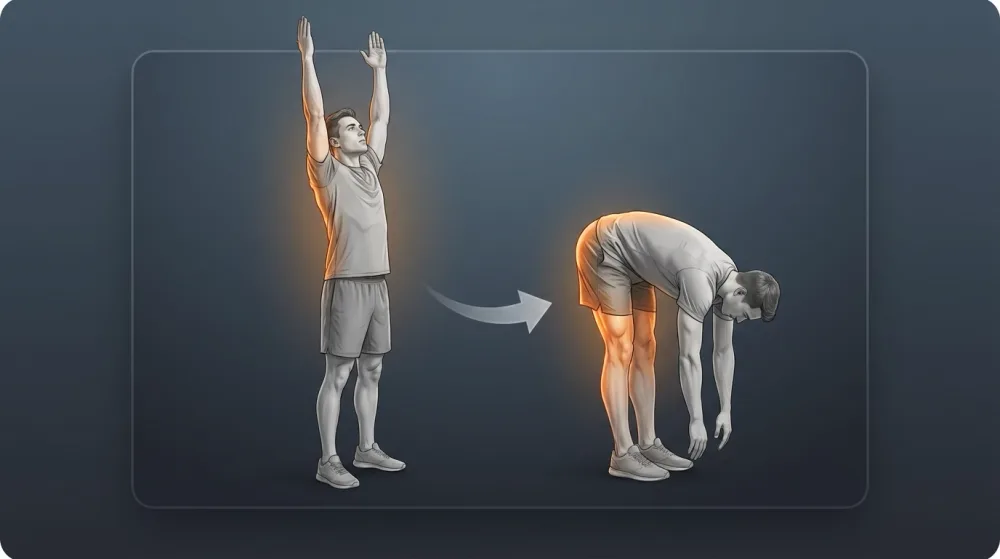
Exercise 7
Standing sunrise
- Dose
- 6 slow cycles
- Rest
- No rush
- Main focus
- Hips, posterior chain, ribcage and calm breathing
Watch for: Reach up as you breathe in, then hinge forward from the hips as you breathe out. Keep a soft bend in the knees. Do not force depth.
Make it easier: Place your hands on your thighs and shorten the fold. This is a calm finish, not a flexibility test.
Before the first run: 5–7 minutes
Find stable, level, non-slip ground away from lift traffic and moving skiers. Ski boots reduce your available movement. Use solid support if the surface is uncertain. Long static holds are not the main part of this sequence.
-
1. Brisk walk or march
60–90 secondsMove your arms and legs until you feel noticeably warmer without becoming breathless.
-
2. Supported calf raises
8 repetitionsHold something stable and raise and lower your heels smoothly. Use only the ankle movement your boots allow.
-
3. Shallow squats
8 repetitionsSend the hips slightly back and bend the knees and hips together. Keep the range small and controlled.
-
4. Lateral weight shifts
6 each sideMove your weight from one leg to the other without jumping. Keep knee and foot aligned.
-
5. Controlled trunk turns
6 each sideTurn the ribcage and arms calmly from side to side while the pelvis stays mostly forward.
-
6. Make the first run easy
One calm runCheck visibility, snow, equipment and how you feel today. Build speed only when everything feels ordinary and controlled.
Five common mistakes
- Turning the warm-up into a tiring mini-workout.
- Starting with fast jumps before balance and landing control are reliable.
- Chasing repetitions while the knees, pelvis or back lose the intended position.
- Chasing muscle burn after you have lost control of the movement.
- Following the template despite poor sleep, other training, your condition that day or insufficient experience.
When this universal session does not fit
This template is for healthy adults who already know basic strength exercises. It cannot place your movement experience, strength, ski technique, current condition or weekly workload in individual context.
An exercise can be too complex even when you feel ready. Fewer repetitions do not solve a coordination problem. Use the support described above, reduce the range or ask a qualified coach to check the starting position.
What the sources support, and what they do not
Alpine-ski research describes a combination of physical and technical demands. Studies in recreational skiers have measured fatigue in the front and back of the thigh after a long ski day. Turnbull, Kilding and Keogh (2009): physiology of alpine skiing, Koller et al. (2015): fatigue after four hours of recreational skiing, Hermann et al. (2023): muscle fatigue in female recreational skiers
General resistance-training evidence supports training muscle function, while warm-up reviews support dynamic movement before performance. None of these studies tested this exact seven-exercise sequence, order or repetition scheme. ACSM (2026): resistance training in healthy adults, Fradkin et al. (2010): systematic review of warm-up, Behm et al. (2016): stretching and immediate performance
Swiss-Ski and Suva provide useful exercise families and warm-up formats. The Swiss-Ski sheets are for children, so their dosage was not copied as an adult prescription. The short routine does not promise perfect performance or an injury-free day. Swiss-Ski: leg exercise sheets, Swiss-Ski: trunk and upper-body exercise sheets, Swiss-Ski: mobility exercise sheets, Suva: warm-up before skiing and snowboarding
Discuss the session with the AI coach
In SlopeReady, you can discuss this template with the AI coach. It can use your saved plan, profile, recent workout summaries and available recovery signals from Apple Health as context. For example, it can propose moving, shortening or replacing a session with a more suitable catalog exercise.
You see the proposed change before you confirm it. The coach does not observe your technique or know how an exercise feels to you, and data or health context may be missing. SlopeReady also does not record workouts, live heart rate or GPS routes.
Product behaviour checked on 12 August 2026. Terms of Use, Privacy Policy