
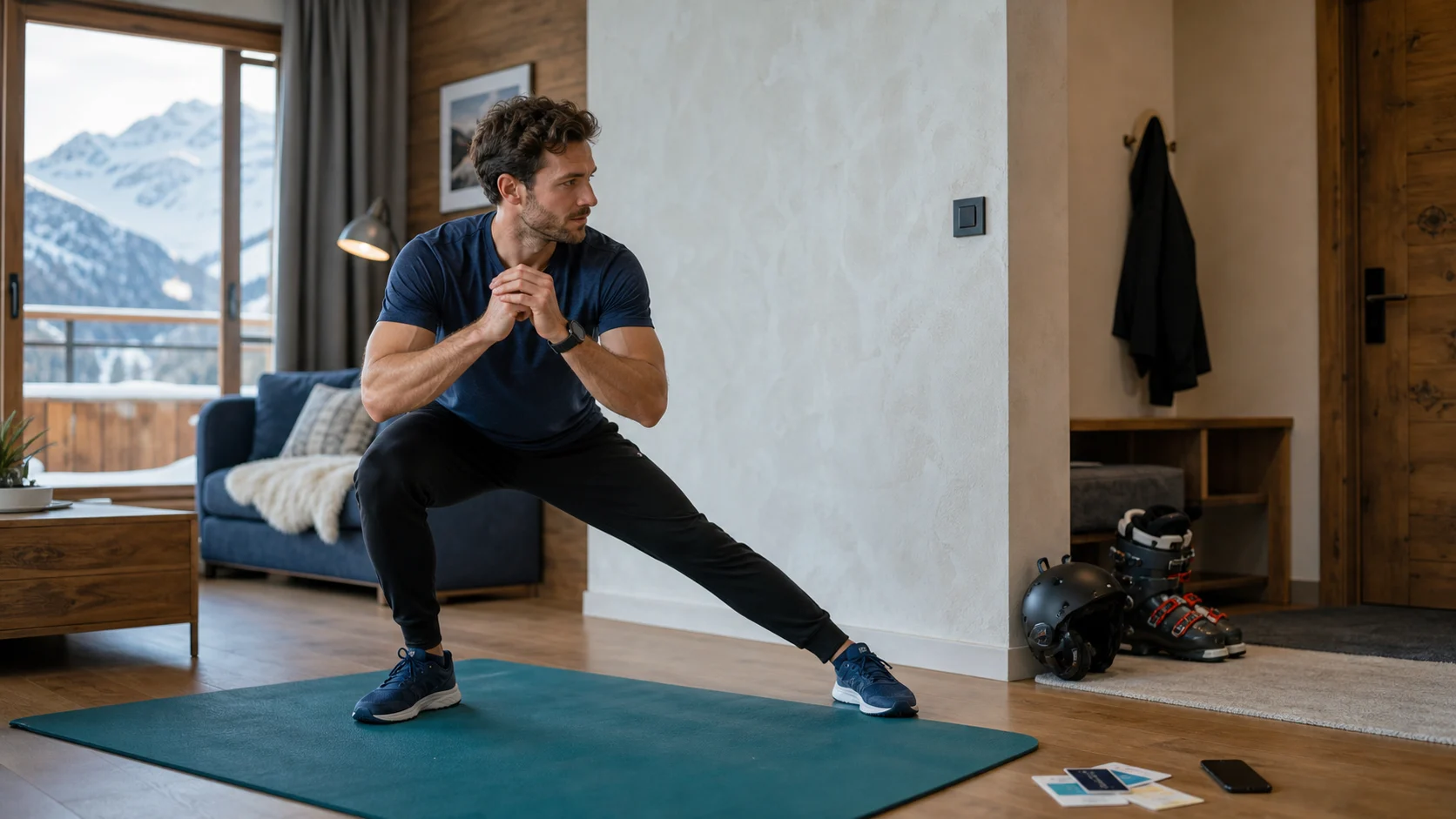
Before you start: space, support and time
Set everything up before you start the timer. That keeps a rest period from turning into a search for furniture.
Clear floor
About 2 × 2 metres, with no loose rug edges, toys or objects that can slide.
Stable support
Use a wall or a heavy chair back. A wheeled office chair is not suitable.
Floor surface
Place a mat or folded towel down for the glute bridge march and dead bug.
Timer
Set 30- and 60-second intervals. Rest is part of the session.
How the 30 minutes fit together
Treat the times as a frame. Controlled repetitions and complete rest periods matter more than finishing to the second.
-
2 min
Set up
Clear the floor, test the chair and place the mat and timer within reach.
-
5 min
Warm up
March and work through five movement patterns at an easy pace.
-
9–10 min
Block A
Leg and hip control for two rounds.
-
9–10 min
Block B
Balance, trunk and ankle work for two rounds.
-
2–3 min
Finish
Walk or march easily, then make one short note.
Warm-up: about 5 minutes
Move without rushing. By the final step, you should feel warmer and still be able to complete each movement at your chosen pace.
-
60 sec
March on the spot
Place the whole foot down and let your arms move naturally.
-
8 reps
Shallow squats
Bend your knees and hips only as far as you can keep your feet and knees steady.
-
6 each side
Lateral weight shifts
Move your hips from one leg to the other without hopping.
-
8 reps
Calf raises
Raise both heels smoothly and lower them under control.
-
6 each side
Standing trunk turns
Turn your chest and arms while your pelvis stays mostly forward.
Block A: control the legs and hips
Complete all three exercises in order. Rest for 30 seconds between exercises and 60 seconds after the third exercise. Then repeat the block once.
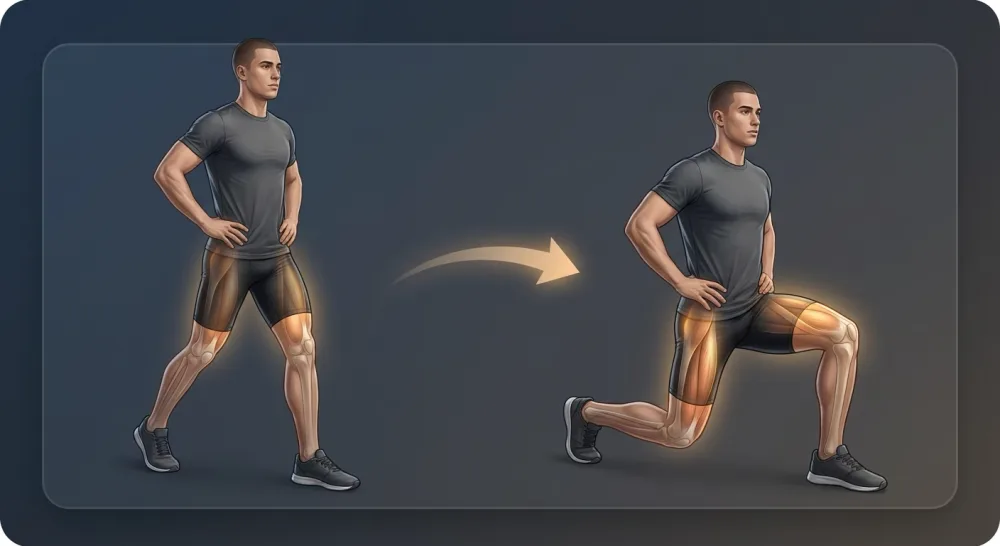
Exercise 1
Forward lunge
- Work
- 8 each side
- Focus
- Front thigh, glutes and leg alignment
Watch for: Step far enough forward. Lower smoothly, point the front knee towards the toes and push back through the whole front foot.
Make it easier: Hold the chair lightly and reduce the depth.
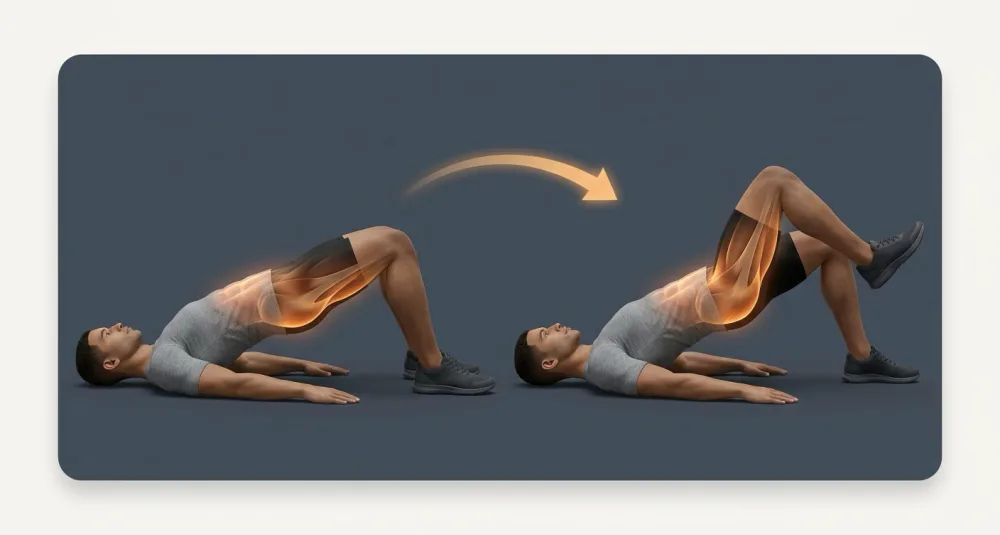
Exercise 2
Glute bridge march
- Work
- 8 each side
- Focus
- Glutes, hamstrings and pelvic control
Watch for: Lift your hips. Raise one foot only as far as you can keep the pelvis level and lifted. Change sides slowly.
Make it easier: Keep both feet down and complete 10 standard glute bridges.
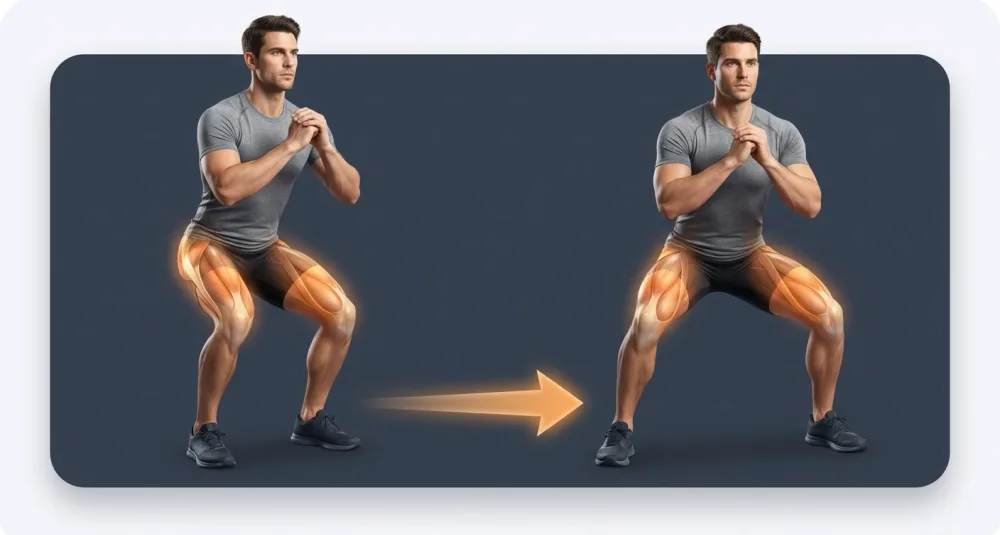
Exercise 3
Lateral squat walk
- Work
- 8 steps each way
- Focus
- Outer hips, glutes and thighs
Watch for: Stay in a shallow squat. Place each foot deliberately and keep the knees pointing in the same direction as the toes.
Make it easier: Stand higher and take smaller steps.
Block B: balance, trunk and ankle
Again, complete the three exercises in order. Rest for 30 seconds between exercises and 60 seconds after the round. Complete two rounds in total.
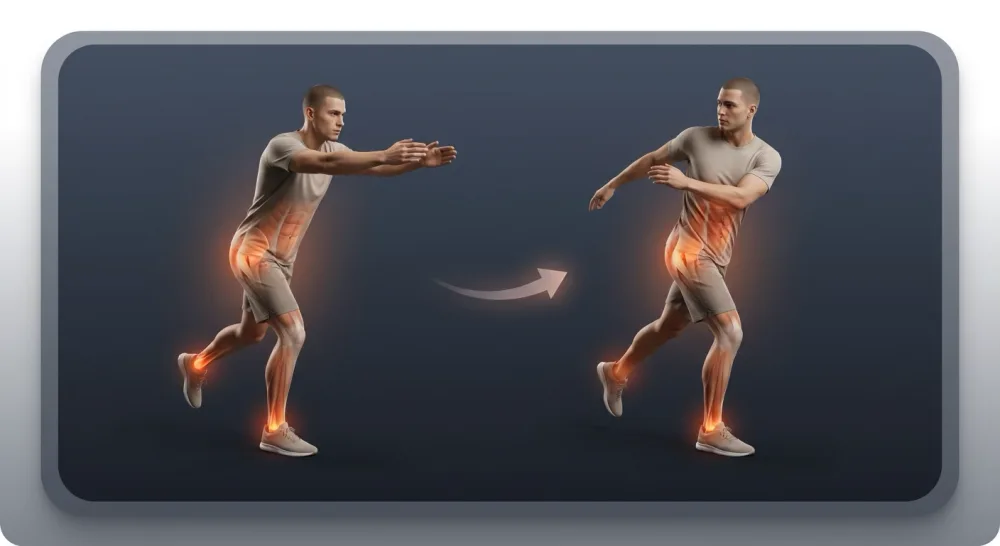
Exercise 4
Single-leg balance with trunk rotation
- Work
- On each leg: 5 rotations right and 5 left
- Focus
- Foot, ankle, outer hip and trunk
Watch for: Keep a small bend in the standing knee. Turn your chest slowly and return to centre each time. Keep the knee and foot pointing the same way.
Make it easier: Touch the wall with one finger and make the turn smaller.
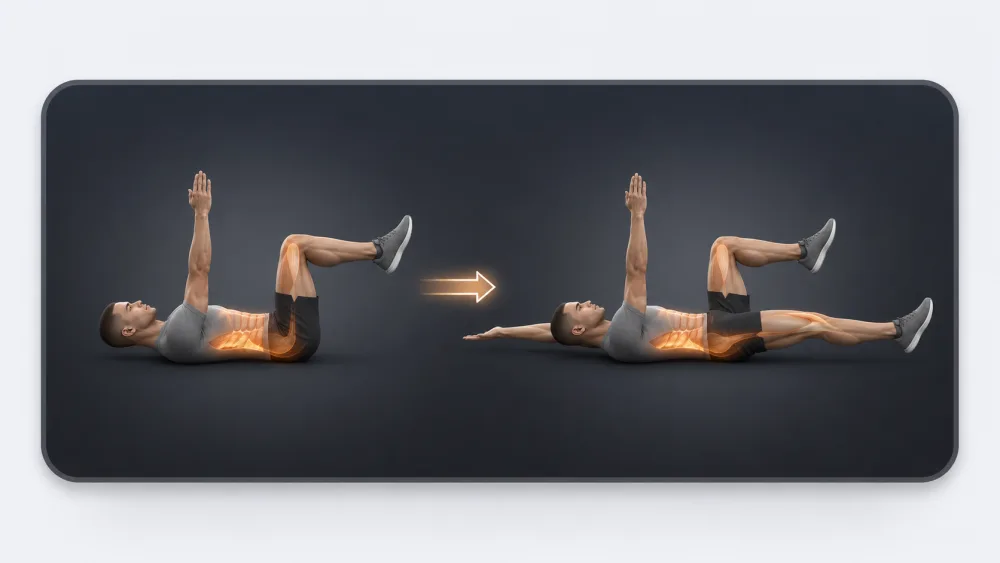
Exercise 5
Dead bug
- Work
- 6 each side
- Focus
- Abdominals and control of the pelvis and ribcage
Watch for: Keep your lower back quiet against the floor. Extend the opposite arm and leg slowly while breathing. Stop the reach before your back lifts.
Make it easier: Tap only the heel to the floor or move the legs without the arms.
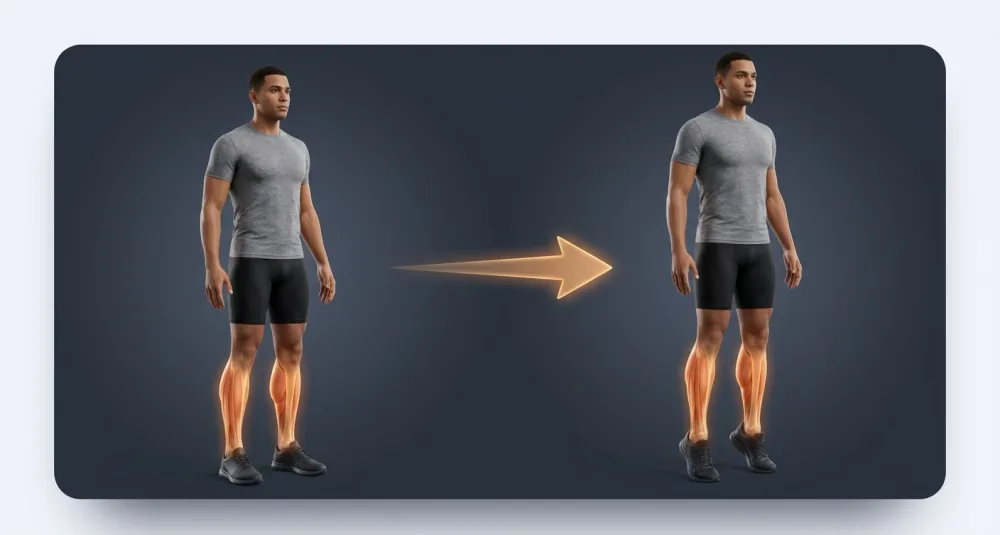
Exercise 6
Calf raise
- Work
- 12 reps
- Focus
- Calves, feet and ankles
Watch for: Raise both heels smoothly, pause briefly at the top and lower slowly. Do not let the ankles roll out.
Make it easier: Hold the wall and reduce the height.
If this is your first attempt
Use the first run as a technique check. It does not need to last as long as the standard session.
- Complete one round of Block A and one round of Block B.
- Use the easier option straight away for any exercise that feels uncertain.
- Keep the full warm-up and two to three minutes of easy movement at the end.
- Note which exercise lost control first. That will help more next time than a fastest finish.
How to progress the session
Start with the smallest suitable step. Add a third round only later, when you can keep smaller changes controlled. Change one variable per session.
Small step: more repetitions
Add 1–2 reps: lunges, bridges and lateral steps up to 10; balance turns up to 6; dead bugs up to 8; calf raises up to 15.
Lower more slowly
Take three seconds to lower in the lunge or calf raise. Keep the number of repetitions and rounds unchanged.
Later, larger step: a third round
Add a third round to Block A or Block B only. That increases that block's volume by 50%. Do not also increase speed or repetitions in that session.
Where the session fits in your week
A general weekly example: schedule the session once or twice on non-consecutive days. If you already do other strength training for your legs and hips, count it as part of the week’s workload. Do not automatically stack this workout beside it; it is not an individual training plan.
One session
For example, home workout on Wednesday. Keep your familiar endurance work and recovery on other days.
Two sessions
For example, the same session on Tuesday and Saturday. Leave several days between them and do not progress both at once.
Why these movements were selected
Research on alpine skiing, mainly alpine racing, links physical demands with ongoing technical control. In 24 healthy, fit recreational skiers, selected measures of eccentric hamstring strength were lower in both thighs after four hours of skiing, and quadriceps strength was lower in one thigh. Turnbull, Kilding and Keogh (2009): physiology of alpine skiing, Koller et al. (2015): strength after four hours of recreational skiing
The ACSM review supports progressive strength work for muscle function and balance in healthy adults, but it is not ski-specific. Fradkin and colleagues support movement before physical performance, but did not test this exact five-minute sequence. American College of Sports Medicine (2026): resistance training for healthy adults, Fradkin, Zazryn and Smoliga (2010): warm-up and physical performance
No source tests these six exercises as one programme, including their order, repetitions, rests, exact five-minute warm-up, finish, weekly frequency or progression. This workout is an editorial training template; Suva served only to compare accessible winter-sport exercise families. Suva: fitness exercises for winter sports
Build on this session
General fitness or ski preparation?
See what your usual training already covers and which demands skiing adds.
Compare general fitness with ski preparationMuscle groups and exercise order
See why leg, hip, balance and trunk work appear in this sequence.
Open the full ski-gymnastics guideTwo or three sessions per week
Arrange strength, endurance and recovery without piling sessions on top of each other.
Open the weekly planning guideBuild over eight weeks
Use a longer horizon when you want to develop repetitions and workload across several weeks.
Open the eight-week planPlan recovery
Separate a day without planned training from everyday movement and deliberate active recovery.
Open the recovery guideDiscuss changes with the AI coach
You can discuss this template with the SlopeReady AI coach. The coach can use your profile, saved plan, recent workout summaries and available recovery signals from Apple Health as context. The coach may, for example, suggest moving or shortening the session or replacing an exercise with one from the catalogue.
You see a lasting plan change before you confirm it. The coach cannot watch your technique or know how an exercise feels, and its data may be incomplete.
The app reads the data you permit through Apple Health for analysis and plan support. It does not write data to Apple Health, start live workout sessions, or record workouts, live heart rate or GPS routes.
Product behaviour checked in the current SlopeReady code on 12 August 2026. Terms of Use, Privacy Policy