
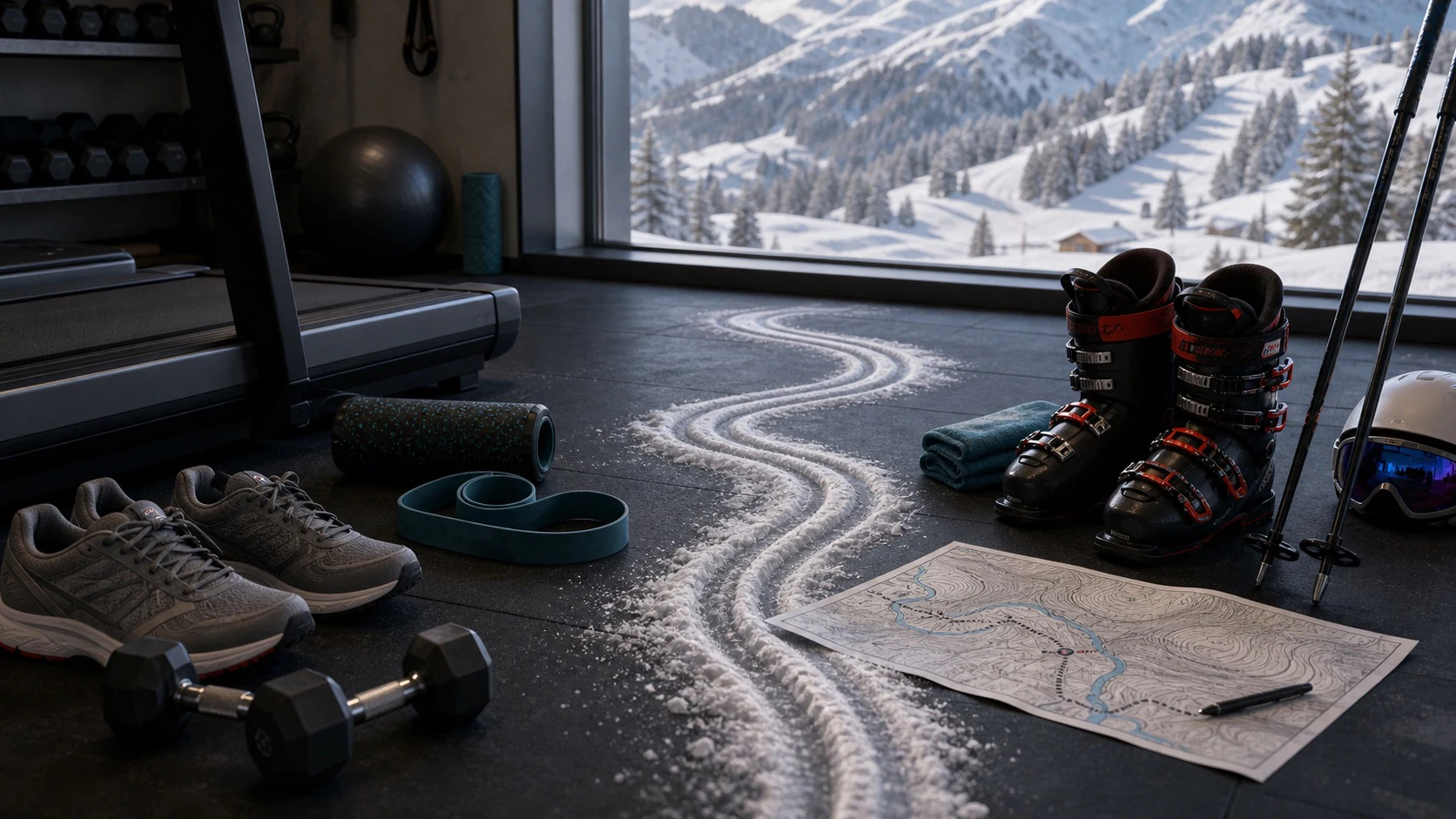
Running builds endurance, and strength training builds force reserve. Skiing can still leave you exhausted because you must use those reserves for repeated leg control, balance, and technical decisions in changing conditions for several hours. Ski fatigue does not, by itself, prove poor fitness, weak legs, or one technique fault.
Your general fitness shows only part of your readiness. A running time or gym strength score says little about how long you can control force through many turns while snow, gradient, visibility, and speed keep changing.
Which features of the fatigue are worth noting first
Record when the fatigue begins, whether it affects your whole body or mainly your thighs, and whether your breathing remains controlled. Also note the terrain, snow, altitude, total duration, what a break changes, and whether your turns become less precise. These observations cannot diagnose the cause, but they can guide your next step.
Five observations and what to do next
| What you notice | What may contribute | What this sign cannot establish | What to do next |
|---|---|---|---|
| You feel whole-body fatigue or breathlessness that is unusual for the effort on easy runs. | Pace, total exertion, sleep, altitude, or a health problem may contribute. | It proves neither poor endurance nor altitude illness. | Reduce the effort. If the breathlessness is unusual for that workload, stop skiing and seek prompt medical assessment. Call emergency services for chest pain or pressure with shortness of breath, dizziness, sweating, or nausea (NHS chest-pain guidance), or for severe breathing difficulty, inability to speak because of breathlessness, sudden confusion, or blue, grey, or very pale skin (NHS breathlessness guidance). |
| Your thighs tire while your breathing remains controlled. | Repeated local muscle work, body position, terrain, and ski-specific muscular endurance may contribute. | It proves neither a poor aerobic base nor one technique fault. | Record how many runs it takes and where the fatigue begins. If it appears very early, a qualified instructor can observe your movement. |
| After several runs, your turns become rushed, less precise, or harder to control. | Fatigue may be affecting repeated coordination and technical decisions. | The change does not prove muscle weakness or identify a single error. | Stop the sequence before you try to replace lost control with more force or speed. Note when the change began and in what conditions. |
| Fatigue appears mainly after several hours or on later days of the trip. | Total time, an unfamiliar volume of repeated turns, and recovery between ski days may add up. | It does not mean your preparation failed. | Compare the duration and pattern between days. Base the next ski day on your actual recovery, not on the number of lift-pass days you bought. |
| You develop sharp pain or pain centred in a joint, numbness, weakness, or symptoms at rest. | Ordinary exertional fatigue does not explain these symptoms well. | The table cannot determine their cause. | Stop skiing and seek prompt medical assessment for acute joint pain, numbness, weakness, or symptoms at rest. Call emergency services if weakness or numbness starts suddenly, follows a head, neck, or back injury, or comes with confusion or trouble speaking or walking (MedlinePlus on numbness and weakness). |
How skiing differs from running
Running repeats a relatively stable movement cycle. In alpine skiing, muscles repeatedly work eccentrically, producing force while lengthening, and isometrically, holding force without much change in length. Balance is also challenged on a slippery incline: uneven terrain, disturbances, and vibration call for continual corrections. Reviews by Ferguson and Burtscher and colleagues describe these features. Both draw mainly on performance and health research rather than explaining one recreational skier’s fatigue.
A review by Turnbull and colleagues covered 29 on-snow studies, nine off-snow studies, and four previous reviews. Most of the evidence concerned competitive alpine skiing, where technical ability was considered an important performance factor. The review cannot predict how tired a recreational skier will feel during a holiday.
In a study by Koller and colleagues, 24 healthy, physically fit recreational skiers, including 14 men and 10 women, skied for four hours. The researchers measured strength before skiing, then one hour and 24 hours afterwards. Eccentric peak torque fell in the muscles at the back of both thighs and only in the left quadriceps. No other strength test changed significantly. This measured torque loss does not explain the particular feeling of fatigue you notice on the slope.
Why repeated force control differs from a gym strength test
A high maximum lift gives you reserve. Skiing asks you to apply part of that force again and again while the inside and outside legs take different roles and the next turn begins. One heavy repetition followed by rest therefore tests something different from a long series of controlled turns.
In a small study of six recreational skiers, participants completed 24 standardised runs. The frequency and timing of quadriceps activation changed between the first and last runs, which the authors interpreted as altered coordination. The study did not compare runners, strength trainees, or different preparation methods. It therefore shows only that peak strength and repeated control answer different questions.
How conditions, technique, altitude, and individual response change the load
Technique can affect how much unnecessary muscle tension you carry. Snow, gradient, visibility, speed, equipment, and total duration also change the task. Early fatigue is not enough to isolate any one of them as the cause.
People also respond differently to the same standardised session. In a study by Finkenzeller and colleagues, 22 experienced skiers, all men, completed ten standardised runs lasting 150–180 seconds each at 80 turns per minute. The researchers identified signs of fatigue in 16 participants, and the group analysis of subjective changes covered this subgroup. Fatigue and worry rose significantly, while vitality and calm fell. Abrupt physiological or biomechanical changes appeared only in some skiers and on different runs, not across the whole group or in all 16.
Lower oxygen availability can add to the strain at high resorts. The CDC Yellow Book states that at about 3,050 metres, inspired oxygen partial pressure is around 69% of its sea-level value. Many pistes and sleeping elevations are lower. Physical fitness and training do not change the risk of altitude illness, and fatigue alone cannot diagnose it.
How to use your observations in preparation
Running remains useful for general endurance, and strength training builds force reserve. Add what happens on the slope: compare when local muscle fatigue begins, how long your turns stay precise, and how you recover between ski days. One observation does not provide a training diagnosis or a universal exercise list.
If your thighs tire early, read the detailed guide to why your thighs burn while skiing. The article on alternating training types helps place different demands within one preparation plan. If fatigue builds on later trip days, add the guide to recovery days.
What SlopeReady can and cannot do
With your permission, SlopeReady reads only the available workout and recovery history in Apple Health. It connects that history with your ski goal and current plan. The app does not record ski runs, measure live heart rate, or track GPS.
SlopeReady cannot see the snow, altitude, your technique, boots, or how you feel on the slope. It does not determine the cause of fatigue or draw confident conclusions when data are incomplete. It can help you view the training and recovery history that is available in the context of your goal and plan.