
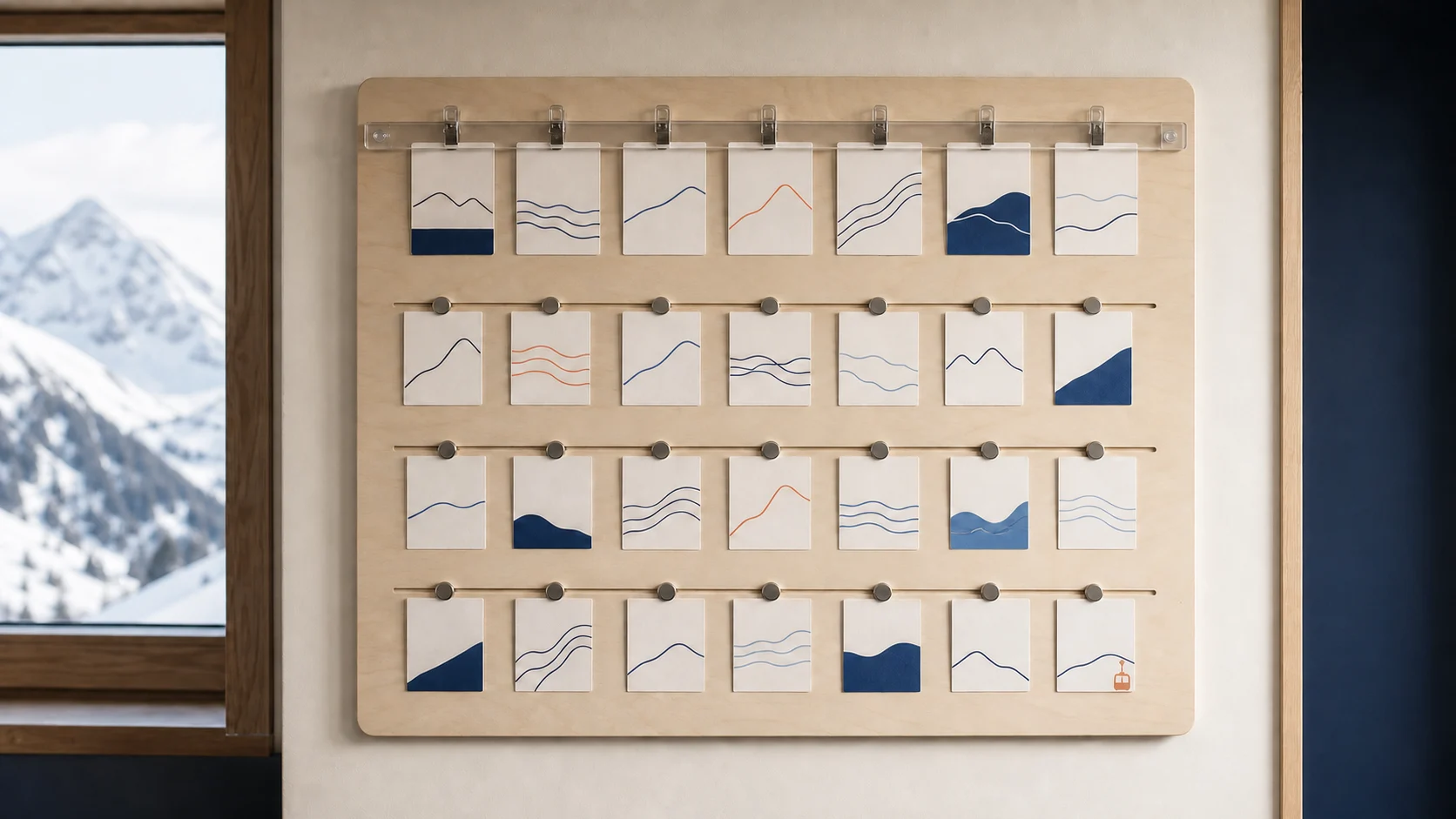
The coming week needs enough stability for you to reserve time around it. The later plan needs room to move because new training and recovery information will arrive before you reach those dates.
Seven days is not a magic training rule. It is a clear SlopeReady product boundary: the nearby calendar stays predictable while the more distant, system-owned part of the plan can adapt.
One plan, two time zones
The SlopeReady plan covers 28 days. This boundary governs automatic regeneration only. You can still make an explicit change to any current or future day.
Sources: How SlopeReady works, SlopeReady data sheet.
How the same 28-day plan behaves
These four cases expose the details that broad promises about an “adaptive plan” tend to skip.
Strength is scheduled tomorrow.
- Automatic update
- New sleep or readiness data arrive.
- Result
- The saved session stays. A daily view may explain today's context without rewriting the plan.
A system-planned endurance session sits 12 days away.
- Automatic update
- The calendar rolls forward the next day.
- Result
- That distant day may be rebuilt using the context available then.
You move a session 18 days away to Friday.
- Automatic update
- The adaptive horizon is rebuilt later.
- Result
- Your explicit Friday edit remains.
A day in the coming week is empty after a long absence.
- Automatic update
- SlopeReady rebuilds the current window.
- Result
- The empty, unauthored day may be filled while existing commitments remain untouched.
Four distinctions worth checking
A useful adaptive plan answers these questions without hiding the rules.
Audit any adaptive training plan in four steps
Use these questions with any training app.
-
Mark the protected dates
Find which sessions cannot change merely because you open the app, sync data, or receive a new measurement.
-
Find the adaptation boundary
Check the first date the system may rebuild and whether it shows a reason.
-
Test one manual edit
Move a distant session, refresh the plan later, and confirm that your chosen date remains.
-
Check consent
A lasting Coach change should show the exact edit before it reaches the plan.
What the research supports, and what it does not
A systematic review and meta-analysis of 13 randomized trials found a small overall effect in favour of reinforced implementation intentions for physical activity. This supports the practical idea of connecting an intention with a time and situation.
The study populations varied widely. The review did not test adaptive training software, calendar stability, or ski preparation. It therefore does not identify seven days as an optimal buffer or show that more automatic changes produce better training.
Sources: Silva et al. (2018).
What SlopeReady does
SlopeReady keeps a rolling plan from today through today + 27. During daily rollover, populated days from today through today + 6 remain unchanged. Only system-generated days from today + 7 through today + 27 may be recalculated.
Your edits and Coach changes you approve are stored as explicitly authored. That includes a rest day you chose. Automatic regeneration cannot replace those decisions.
SlopeReady does not record workouts, live heart rate, GPS, or ski runs. With your permission, it reads available Apple Health data, interprets the context, and helps you manage the plan.